Latest revision 05-08-2024
index
$
\def \hieruit {\quad \Longrightarrow \quad}
\def \met {\quad \mbox{with} \quad}
\def \EN {\quad \mbox{and} \quad}
\def \SP {\quad ; \quad}
\def \half {\frac{1}{2}}
$
A Basic Equation
There is another interesting consequence that can be drawn from formulas in the Simplification section.
$$
1+\half H_i (T-T_0) = e^{H_i/2.(t-t_0)} \approx 1 + \frac{1}{2}H_i(t-t_0) + \frac{1}{2}\left[\frac{1}{2}H_i(t-t_0)\right]^2
$$
Let both the Atomic and Orbital clock be synchronized as usual ($t_0=T_0$) and let them run free for a century, that is
$$
T-T_0 = (\mbox{century})_T \quad \mbox{and} \quad t-t_0 = (\mbox{century})_t
$$
Then we see that the Atomic clock is running faster than the Orbital clock:
$$
(\mbox{century})_T - (\mbox{century})_t \approx \frac{1}{4}H_i(\mbox{century})^2
$$
Calculation (with MAPLE) using Hubble time
and the age of the earth as another possibility:
# Seconds in a year
year := 31556926;
# Age of the earth
earth := 4.543*10^9;
# Hubble constant earth
hubble := 2/(earth*year);
# Running faster
one := hubble*(100*year)^2/4;
# Hubble constant universe
hubble := 1/(4.55*10^17);
# Running faster
two := hubble*(100*year)^2/4;

                        one := 34.73137355 # 34 seconds/century
                        two := 5.471646038 # 5.4 seconds/century
There is a hidden assumption in all of the above:
the reference (atomic & gravitational) time stamp $t_0=T_0$ is not an absolute constant. Especially the Hubble parameter
is linked to that time stamp, via $\,H_i=2/(T_0-A)\,$. So the Hubble "constant" becomes different with every new measurement.
Thereby introducing a relative error in the Hubble time with an order of magnitude $10^{-9}$ (which can of course be neglected
in practice).
Questioned by somebody: How is the Universe's Expansion Accelerating if the Hubble Constant is Decreasing? The accepted answer says:
The Hubble parameter is defined as the rate of change of the distance between two points in the universe, divided by the distance
between those two points. The Hubble parameter is getting smaller because the denominator is getting bigger more quickly than the
numerator. Indeed, because the numerator is $\,2\,$ and the denominator is $\,T_0-A\,$ with observation time $\,T_0\,$
continuously increasing. Beware however, there is a Hubble tension involved in the end!
In the future, the cosmological constant $\Lambda$ could result in an exponential expansion with time. A simple piece of maths
shows you that the Hubble parameter is a Hubble constant only for an exponential expansion. Not in the future; that exponential
expansion is here and now and has never been otherwise. And there is no such thing as a cosmological constant.
Let's consider again Newton's second law: $\vec{F}=m.\vec{a}$ with $\vec{F}=$ force, $m=$ mass and $\vec{a}=$ acceleration.
In UAC there is a difference between Gravitational time $\,T\,$ and Atomic time $\,t\,$.
With Newton's Laws alone - the time scale is Gravitational. Let $\vec{r}=$ be the position vector. We have to evaluate
acceleration at an orbital time scale:
$$
\vec{a}_T = \frac{d^2\vec{r}}{dT^2} = \frac{d}{dT}\left(\frac{d\vec{r}}{dt}\frac{dt}{dT}\right) =
\frac{d}{dT}\left(\frac{d\vec{r}}{dt}\right)\frac{dt}{dT} + \frac{d\vec{r}}{dt}\frac{d}{dT}\left(\frac{dt}{dT}\right) =
\frac{d^2\vec{r}}{dt^2}\left(\frac{dt}{dT}\right)^2 + \frac{d\vec{r}}{dt}\frac{d^2t}{dT^2}
$$
Employing Milne's Formula we have:
$$
\frac{dt}{dT} = \frac{T_0-A}{T-A} \hieruit \frac{d^2t}{dT^2} = - \frac{T_0-A}{(T-A)^2} \hieruit \\
\vec{a}_T = \frac{d^2\vec{r}}{dT^2} = \frac{d^2\vec{r}}{dt^2}\left(\frac{T_0-A}{T-A}\right)^2
- \frac{d\vec{r}}{dt}\left(\frac{T_0-A}{T-A}\right)^2/(T_0-A)
$$
With Narlikar's Law and formulas in Hubble Parameter:
$$
\frac{m}{m_0} = \left(\frac{T-A}{T_0-A}\right)^2 \hieruit m.\vec{a}_T =
m_0 \left[\frac{d^2\vec{r}}{dt^2} - \frac{d\vec{r}/dt}{T_0-A}\right] \\
\frac{m}{m_0} = e^{H_i(t-t_0)} \hieruit \left(\frac{m}{m_0}\right) \vec{a}_T = \vec{a}_T\,e^{H_i(t-t_0)} =
\frac{d^2\vec{r}}{dt^2} - \half H_i \frac{d\vec{r}}{dt}
$$
The exponential decay factor can be written as follows, with $\,r=c_0(t_0-t)\,$ as the distance to a cosmic object (in the past).
$$
e^{H_i(t-t_0)} = e^{-H_i(t_0-t)} = e^{-H_i/c_0\,\cdot\, r}
$$
The exponential decay factor turns out to be immensely large, about "the size of the universe" $=c_0/H_i\,$ according to some.
The end result shall be called A Basic Equation of UAC theory:
$$
e^{-H_i/c_0\,\cdot\, r}\;\vec{a}_T = \vec{a}_t - \half H_i\,\vec{v}_t
$$
Where $H_i=$ (intrinsic) Hubble parameter, $c_0=$ speed of light in empty space (and atomic time), $r=$ distance to a cosmic object
(in the past), $\vec{a}_T=$ acceleration in orbital time, $\vec{a}_t=$ acceleration in atomic time, $\vec{v}_t=$ velocity in atomic time.
An alternative derivation follows here.
$$
\vec{a}_T = \frac{d^2\vec{r}}{dt^2}\left(\frac{dt}{dT}\right)^2 + \frac{d\vec{r}}{dt}\frac{d^2t}{dT^2} \qquad \mbox{and} \qquad
\half H(t-t_0) = \ln\left[1+\half H (T-T_0)\right] \\
\frac{dt}{dT} = \frac{1}{1+H/2.(T-T_0)} \hieruit \frac{d^2t}{dT^2} = - \frac{H/2}{\left[1+H/2.(T-T_0)\right]^2} \\
\vec{v}_T = \frac{d\vec{r}}{dT} = \frac{d\vec{r}}{dt}\frac{dt}{dT} = \vec{v}_t\frac{1}{1+H/2.(T-T_0)} = \sqrt{\frac{m_0}{m}}\,\vec{v}_t \\
\vec{a}_T = \frac{d^2\vec{r}}{dT^2} = \frac{d^2\vec{r}}{dt^2}\left(\frac{1}{1+H/2.(T-T_0)}\right)^2
- \frac{H}{2}\frac{d\vec{r}}{dt}\left(\frac{1}{1+H/2.(T-T_0)}\right)^2 \hieruit \\
\left[1+\half H(T-T_0)\right]^2 \vec{a}_T = \vec{a}_t - \half H\,\vec{v}_t
\quad \mbox{;} \quad \frac{m}{m_0}\vec{a}_T = \vec{a}_t - \half H\,\vec{v}_t
\quad \mbox{;} \quad e^{H(t-t_0)}\,\vec{a}_T = \vec{a}_t - \half H\,\vec{v}_t
$$
Specified for quantities here and now, that is under earthly circumstances, we get that $t=t_0=T=T_0,m=m_0$. As a consequence,
nearby velocities are insensitive to the orbital/atomic time frame but the same does not hold for accelerations:
$$
\vec{v}_T = \vec{v}_t \qquad \mbox{but} \qquad \vec{a}_T = \vec{a}_t - \half H\,\vec{v}_t
$$
The Earth's Rotation Retardation
There are Difficulties with the Predictions, as mentioned in secion 2.3. of
the book Origin of Inertia. Extended Mach's Principle and Cosmological Consequences
by Amitabha Ghosh. It is now an established fact that
the spin motion of the Earth is gradually slowing down, and the magnitude of this secular retardation is about $\,6 \times 10^{-22}\;
rad/s^2\,$. The conventional explanation [ .. ] encounters serious difficulties [ .. ]. That amount of information is already
sufficient. According to our own theory we have - as repeated from the above:
$$
\vec{a}_T = \vec{a}_t - \half H_i\,\vec{v}_t
$$
Here $\,\vec{a}_T\,$ is the "true" Newtonian acceleration and $\,\vec{a}_t\,$ the acceleration as measured nowadays
with atomic clocks. All accelerations are proportional with $R=$ radius of the earth. (Due to perpetual synchronization, it is allowed
to take $\,t=t_0\,$) If there is a discrepancy $\,\Delta\omega\,$ between the orbital and atomic angular velocities, then it must being
caused by the negative term, which is a vector in tangential direction slowing down the rotation. The calculation is a one-liner:
$$
- \half H_i \left| \vec{v}_t \right| = - \half H_i\,\omega\,R \hieruit \dot{\omega} = - \half H_i \left(\frac{2\pi}{\mbox{day}}\right)
$$
# Age of the earth
earth := 4.543*10^9;
# Seconds in a year
year := 31556926;
# Hubble parameter
hubble := 2/(earth*year);
# Seconds in a day
day := 60*60*24;
# Rotation of the earth
omega := 2*Pi/day;
# Retardation
slower := evalf(omega*hubble/2);
                                             -21
                    slower := 0.5072577580 10
We find that the retardation is about $\,5 \times 10^{-22}\;rad/s^2\,$.
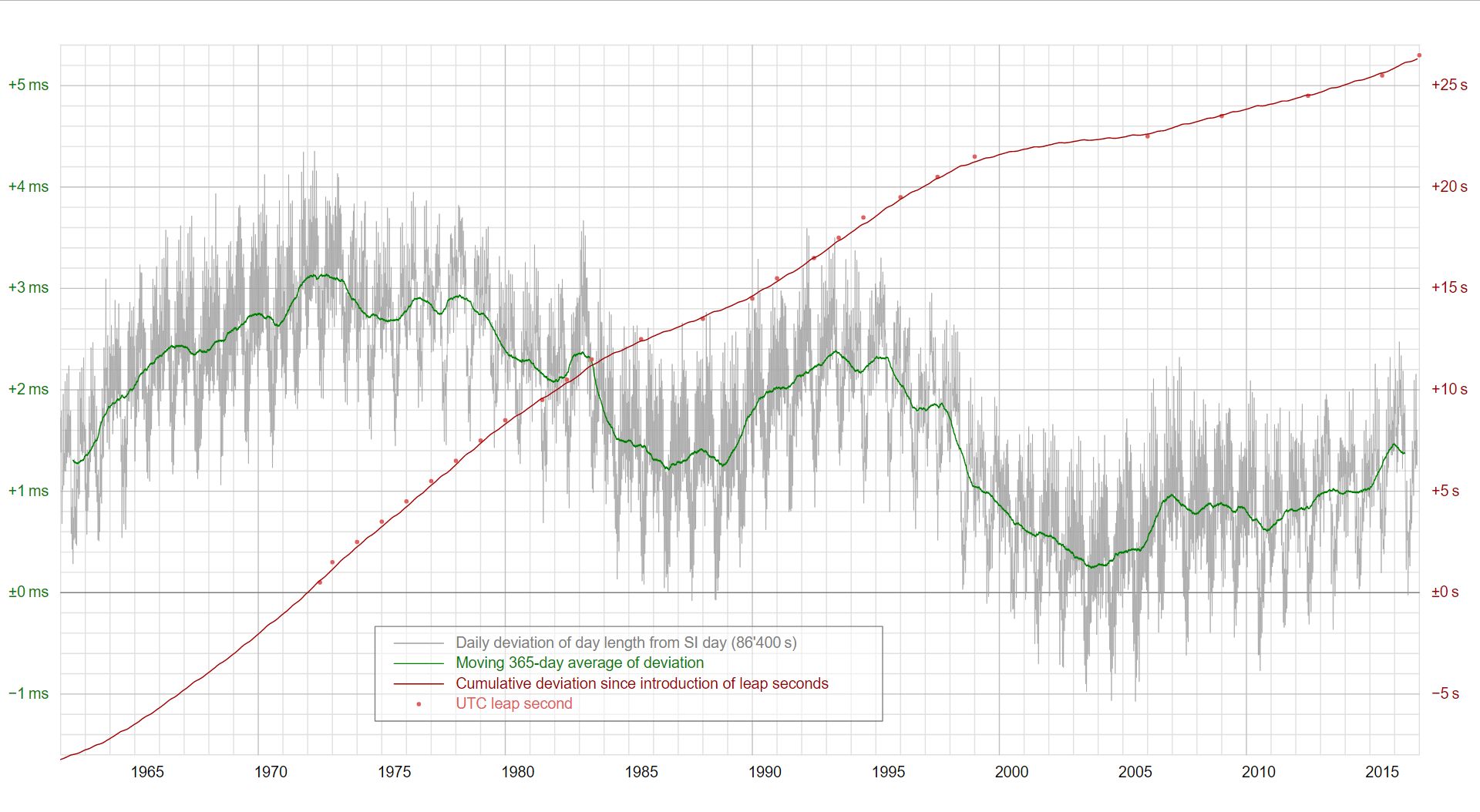
There is indeed a small but positive discrepancy between atomic time and orbital day
time, which is exemplified by the existence of Leap Seconds.
Atomic clocks will run too fast in the long run. Therefore it is necessary to "stop" them once or twice in a year or so
(source of picture = Wikipedia):
By taking a good look at another picture from the Wikipedia reference, we could
have made an estimate. Much better data are obtained, however, from the following Wikipedia reference:
$\,\Delta T\,$ (timekeeping).
Quote: The value of $\Delta T$ for the start of 1902 is approximately zero; for 2002 it is about 64 seconds.
So the Earth's rotations over that century took about 64 seconds longer than would be required for days of atomic time.
Let's see if we can reproduce this. According to common kinematics we have, after a century of the earth's rotation,
for its shortage of radians:
$$
\Delta \theta = \frac{1}{2}\dot{\omega}\,(\mbox{century})^2
$$
It's a simple matter to derive the number of leap seconds from this, but we are a factor of two off:
theta := slower/2*(100*year)^2;
leaps := evalf(theta*day/(2*Pi));

                         leaps := 34.73137354
As has been explained in the above, Atomic clocks are running faster than Orbital clocks,
with an amount of $H_i(\mbox{century})^2/4$ .
For the Hubble constant of the earth, the leap second as calculated by this effect has the same magnitude:
                          one := 34.73137355 # 34 seconds/century
                        leaps := 34.73137354
Not at all by coincidence, because the former turns out to be another calculation for the latter:
$$
\mbox{leaps} = \frac{1}{4}H_i(\mbox{century})^2 =
\half\left[\half H_i \left(\frac{2\pi}{\mbox{day}}\right)\right](\mbox{century})^2\left(\frac{\mbox{day}}{2\pi}\right)
$$
Remember, however, that observation of the leap interval reveals that it is about 64 seconds.
Instead of the earth rotating on its axis, consider a satellite orbiting the earth.
The mathematics is essentially the same one-liner as before. Attention is restricted to the secular retardation.
$$
\vec{a}_T = - \half H_i \left| \vec{v}_t \right| \hieruit \dot{\omega} = - \half H_i\,\omega
$$
But wait! This is a differential equation. And it can be solved, before proceeding any further.
$$
\omega = \omega_0\,e^{-H_i/2.t} = \omega_0\left(1-\frac{H_i}{2}T\right)
$$
where atomic time $t$ has been converted into into orbital time $T$ and
$$
\omega_0 = v/a = \frac{\sqrt{GM/a}}{a}
$$
$G=$ gravitational constant, $M=$ mass of the earth, $a=$ radius of orbit, assumed circular, $v=$ velocity in orbit.
Upon further integration it follows that
$$
\theta = \omega_0 \int_0^T \left(1-\frac{H_i}{2}\tau\right)d\tau = \omega_0\left(T - \frac{H_i}{4}T^2\right)
$$
A secular retardation is observed again, which is subtracted from the classical linear term $\omega_0 T$ . Taking ($T=$ century) we get
$$
\Delta\theta = - \frac{H_i}{4}\omega_0\,(\mbox{century})^2 \quad \mbox{with} \quad \omega_0 = \frac{\sqrt{GM/a}}{a}
$$
An important thing to notice is that, with the satellite orbit instead of the rotating earth, any arbitrary factor $\omega_0$
will be cancelled out too in the end. Reason is the conversion factor (angle → seconds), being equal to $T_c/(2\pi)=1/\omega_0$ ,
where $T_c$ is the time needed for completing one round. Conclusion: leap seconds per century in an orbit are, independent of any
other parameters, given by $\Delta T_{century} = - H_i/4(\mbox{century})^2$ .
There are in any case two calculations leading to the same outcome:
$$
\begin{matrix}
(\mbox{century})_t - (\mbox{century})_T \approx - H_i/4(\mbox{century})^2 & \mbox{(1)}\\
\Delta T_{century} = - H_i/4(\mbox{century})^2 & \mbox{(2)}
\end{matrix}
$$
It is now obvious, however, that these two calculations correspond with two different phenomena. The first one describes how
atomic clocks are running ahead of orbital clocks. The second one describes that there is an additional time leap needed for an orbit(al
clock) to complete its periods (over a century).
For our leap second this means that the outcome $34.73137354$ should be taken twice instead of once.
Thus improved calculation of the leap interval reveals that it is about $2\times 34.73137354 = 69.46274708 \approx$ 69 seconds.
Furthermore it is clear that the "Age of the Earth" is relevant for the calculations and not the "Age of the Universe",
whatever the latter might mean. So what we finally have is $H_i=2/\mbox{Age}$ and leaps $=2\times (\mbox{century})^2 /(2\times \mbox{Age})$ .
In words:
$$
\mbox{# leap seconds} = \frac{(\mbox{ # seconds in a century })^2}{\mbox{age of the earth in seconds}}
$$