The Variable Mass Theory
and Gravitational Paradoxes
Han de Bruijn, retired Engineer,
Theoretical Physicist by education
E-mail: umumenu@gmail.com
ABSTRACT
Essential reading is the first article in the series, which is about Atomic Time, Orbital Time and the Variable Mass Theory. It has been shown in this article that General Relativity (GR) can be effectively replaced by Variable Mass (VM) in a Static Euclidean Universe (SEU), which is eternal in Atomic time and has moments of creation (i.e. one or more beginnings) in Orbital time.
The cosmological redshift is intrinsic: it only depends on variable (elementary particle rest) mass. Because that is where the VM theory has been designed for.
A convenient consequence is that Newton's theory is good enough for describing gravity at a cosmic scale. It is demonstrated that the latter, when combined with the Variable Mass hypothesis, solves for Gravitational Paradoxes and leads to a Zero-energy universe. A crude estimate for the Pioneer Anomaly is obtained as well.
CONTENTS
- Static Euclidean Universe
- Infinite and Eternal
- NO curved Space-Time
- The Big Bang never happened
- Cosmological Redshift
- A Paradox of Gravitation
- Solution by Simeon Albert
- Seeliger's Paradox
- E = mc2 via Mach
- Pioneer Anomaly
- References
1. Static Euclidean Universe
The "observed" universe, so much celebrated by certain empiricists, has an obvious drawback: it changes every year with
the advent of a new telescope. It is hardly possible to build a sensible, let it be predictive, theory upon such a wildly
varying concept. So let us make a fresh start with theory, apart from being "observed" or not.
Essential reading is the first article in this series, which is called Atomic Time, Orbital Time and the Variable Mass Theory [1] The Variable Mass Theory (VM) is compatible with a static Euclidean universe, which is eternal in Atomic time and has moments of creation (i.e. one or more beginnings) in Orbital time. Moreover it turns out that - in order to arrive at very much the same results as obtained by Arp and Narlikar in [32] - General Relativity is not needed. GR has not become invalid, but it's rather irrelevant at a cosmic scale. More systematically:
- The universe, as something that contains everything, does not exist.
Way of speaking: it's infinite.
- There is space, there is time, but there is NO space-time.
Space is infinite, (atomic) time is eternal.
- There does not exist another geometry in nature than common Euclidean geometry.
There is NO curved space-time.
- Consequently, a Static Euclidean Universe (SEU), as advocated by Eric Lerner [2], shall be adopted.
- Mainstream Big Bang theory is challenged by proposing that the universe is not expanding.
With other words:
The Big Bang never happened [3].
- For the purpose of cosmology, GR is effectively replaced by VM.
A convenient consequence is that Newton's theory of gravity is sufficient at a cosmic scale.
- It will be assumed that the mass density distribution in SEU cosmos is uniform.
With a pinch of salt, as will be shown in section 9 of the paper.
Some of the above will need additional explanation.
2. Infinite and Eternal
Out theory starts with the assumption that the universe is infinite in space and time. Because of Russel's Paradox [5] and Infinitum Actu Non Datur [6] this effectively means that "There is no Universe" [7] at all; in the sense that there would exist something that contains everything. Our infinite universe, according to Gauss' dictum below, is just a way of speaking:
[ Was nun aber Ihren Beweis für (1) betrifft, ]
so protestiere ich zuvörderst gegen den Gebrauch einer unendlichen Größe
als einer Vollendeten, welcher in der Mathematik niemals erlaubt ist. Das
Unendliche ist nur eine façon de parler, indem man eigentlich von Grenzen
spricht, denen gewisse Verhältnisse so nahe kommen als man will, während
andern ohne Einschränkung zu wachsen verstattet ist.
( C.F. Gauss [in a letter to Schumacher, 12 July 1831] )
I protest against the use of infinite magnitude as something completed, which
is never permissible in mathematics. Infinity is merely a way of speaking, the
true meaning being a limit which certain ratios approach indefinitely close,
while others are permitted to increase without restriction.
Carl Friedrich Gauss [8]
(30 April 1777 - 23 February 1855) was a German
mathematician and physical scientist who contributed significantly to many
fields, including number theory, statistics, analysis, differential geometry,
geodesy, geophysics, electrostatics, astronomy and optics. Gauss referred to
mathematics as "the queen of sciences", hence as a science.
3. NO curved Space-Time
A first consequence of the hypothesis that our universe is "infinite" is the nature of geometry,
which is simply Euclidean and flat. There is no need at all for the curved
Spacetime geometries [9] of General Relativity. An infinite Euclidean universe
readily solves the Flatness problem [10] and the
Horizon problem [11] in the first place. It does
- of course - not solve the Magnetic monopole [12] problem, which is just another artefact, arising from distorting Maxwell's classical laws of electromagnetism.
In Einstein's General Relativity theory, a four-dimensional space-time
manifold [13] is employed, which is curved into
nothingness. The latter may be regarded as a distortion too. By the way, nothing is special about the
mathematics of tensor calculus in GR : Solid Mechanics [14] extensively uses tensors to describe stresses, strains,
and the relationship between them (Wikipedia). A surface may be bent in a space with a higher dimension.
But nowhere in Solid Mechanics - or elsewhere in classical physics - there exist
Applications of Manifolds not embedded in Euclidean Space [15].
Apart from physics, the whole idea of Minkowski space-time [16] is doubtful in another respect. Let us quote from an article by Norman (N J ) Wildberger,
titled Evolution versus Intelligent Design: a mathematician's view [17].
Going more out on a limb, I will call on modern neuro-psychology and Einstein's theories of relativity
to destabilize the familiar view of the universe as a dynamic place which is unfolding as we watch, along lines
that we can potentially understand. I will suggest that the world has already been created in its historical entirety.
We are just too low dimensional and internal to it to witness it across both space and time. This is consistent with
the idea of an omniscient deity, whose existence probably implies that everything is already known, and so any idea
of free will must be an illusion. Alright, so humanity is guilty of nothing. Because we couldn't
have done otherwise, even if we wanted to.
Or, as formulated by Doug Marett (2013) in his
Spacetime- Right or Wrong? [18]:
What space-time implies is that all events, past, present and future, are already written in the fabric of space.
Such a conclusion relegates all human activity to simply being automatons acting out the frames of a preordained film strip.
If we were to believe Einstein we would have to believe that there is no free will at all.
That in and of itself should be reason enough to reject the space-time concept without further consideration!
From Relativity Reexamined [19] at page 29: Einstein wanted to reduce all physics to pure geometry; he
thought that a conveniently curved space-time universe would provide an explanation for all physical laws from electromagnetism
to gravitation. This was his avowed aim and he worked toward this goal for half of his life. [ .. ]
But the goal was never reached. Einstein managed to interconnect curved geometry and gravitation in a brilliant way, but
his unitary theory, as he called it, was never achieved.
A chain reference in our key article [1] is the 1993 publication [32] by Jayant Narlikar [4] and Halton Arp [33]. From that publication we quote: Finally, the Euclidean, flat spacetime becomes a natural, primary reference frame in which cosmological processes are most simply described. Actually Narlikar has proved herewith that General Relativity is redundant on a cosmic scale.
The geometries in Einstein's General Relativity theory have been made "possible" by the discovery
of Non-Euclidean geometry [20] (Wikipedia) in the beginning of the 19th century. This has lead to the
(mis)understanding that non-Euclidean geometries might possibly be relevant to physics. However, the
the only thing it shows is that Euclid's Fifth's Postulate - the one of the parallel lines - cannot be
deduced from the other postulates; it's an independent axiom. Which as such is an important result indeed.
Non-Euclidean geometries can always be embedded in Euclidean geometry - there are many
models of non-Euclidean geometry [21] in common geometry.
In a posting at Mathematics Stack Exchange, titled
Non-Euclidean Geometrical Algebra for Real times Real? [22], it is argued that Euclid's Fifth's
Postulate is not only essential for Euclidean geometry, but it's also essential for elementary algebra.
I have yet to see any decent example contradicting this evidence: without the axiom of parallel lines
elementary algebra cannot even exist. However, Einstein's tensor calculus eventually rests on elementary
algebra. How then can space-time of General Relativity be non-Euclidean?
4. The Big Bang never happened
Let's proceed with another quote from the above mentioned article [17] by N J Wildberger:
Scientific types ought to be a bit more open-minded about things which border on the unknowable.
Dramatic denials of God or any kind of cosmic intelligence by biologists, esteemed as they may be in their own communities, seem to me to be almost as unjustifiable as the emphatic assertions of religious extremists,
or the overly confident descriptions of the first trillionth of a second by Big-Bangers. Namely according to the standard
Chronology of the universe [23] (Wikipedia).
Another quote comes from the book by Hans Jörg Fahr - Mit oder ohne Urknall [24] - and is copied / translated from page 33 without permission. It is noticed that page 314 contains literally the same piece of text, unless there is something wrong with my memory. Or the message is so important that it cannot be repeated often enough.
Starts with a Bang [25]:
|
Warum also drängt sich das Bild des Urknalls dennoch dem menschlichen Verstand mit so starker Suggestivität auf, förmlich wie eine unvermeidliche Vision? Natürlich haben
Bilder einer Atombombenexplosion hierbei ihre ungeheuerliche Suggestivkraft entfaltet. Doch fragt man sich dann
aber angesichts solcher Bilder: Entsteht hier eine Welt? Oder vergeht hier eher eine? Auch bei Bildern einer Supernova
Explosion geht es einem kaum anders; auch hier glaubt man so etwas wie einen lokalen Weltbeginn wahrzunehmen, und
man fragt sich: Könnte nicht vielleicht die Welt als ganze in Form einer globalen Meganova-Explosion, sozusagen
wie aus einer gigantischen Wasserstoffbombe hervorgegangen sein?
| |
So why is the image of the Big Bang so pressing
upon the human mind with such strong suggestiveness,
punctiliously like an inevitable vision? Of course images
of an atomic bomb explosion have meanwhile unfold
their tremendous suggestive power. Yet one is asking
in the face of such images: is a world emerging here? Or
does one rather perish? Also with images of a supernova
explosion things go hardly different; here also one believes
to perceive something like a local world beginning, and
one wonders: Couldn't the world as a whole have been born
in the form of a global meganova explosion, so to speak
as if it had emerged from a gigantic hydrogen bomb?
|
The glorification of violence is indeed Bankrupting Physics.
Think about particle accelerators for example, especially the Large Hadron Collider [26]. As if Depth of Truth is proportional to Heaviness of Bombardment. As if all this smashing of matter can
reveal anything else than space debris. The Embarrassing Nonsense of Particle Physicists - No, we do not need a New Collider [27].
It is clear, however, that modern physics is herewith just following a common trend in our nowadays "civilized" society,
where you can hardly watch a movie without a murder in it. Death seems to be more interesting than life. Standard (cosmological) models of nowadays physics say more about us humans than they reveal about the outside world.
But okay, let's forget about all this and go back to business. Is it true that no other than
Censored Papers Demolish the Big Bang Hypothesis [28]?
According to the Big Bang model, any Static Euclidean Universe is out of the question indeed. One of the most frequently
employed arguments to defend this stand is Olbers' Paradox (Wikipedia) [29] which is also known as the "dark night sky paradox".
We certainly have to deal with Olbers' Paradox in a SEU. However, it's not impossible that observational evidence is in favour of the latter. Particularly relevant in this respect is the information that has recently reached us via the James Webb Telescope [31].
5. Cosmological Redshift
Cosmological Redshift [34] is the phenomenon that all wavelengths $\lambda$ as received from cosmic objects - in the past - are larger than corresponding wavelengths $\lambda_0$ here and now on earth. Expressed into common $z=$ redshift notation that is:
$$
z = \frac{\lambda-\lambda_0}{\lambda_0} = \frac{\lambda}{\lambda_0} - 1 \gt 0
$$
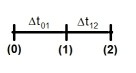
Take a look at the picture below, depicting a timeline running backwards (= forward distance) in cosmos.
Let (0) be our position on earth, (1) is the position of a far away civilization like ours, (2) is the position of a galaxy observed by observers on both habitable planets (0) and (1).
Let $\lambda=$ wavelength of light. Then it is mathematically obvious that:
$$
\frac{\lambda_1}{\lambda_0} \frac{\lambda_2}{\lambda_1} = \frac{\lambda_2}{\lambda_0}
$$
And therefore, by definition of any redshift as $z_{ab}=(\lambda_b-\lambda_a)/\lambda_a$ :
$$
1+z_{02} = (1+z_{01})(1+z_{12})
$$
It is reasonable to assume that the whole $\Delta t_{02}$ is the sum of the parts $\Delta t_{01}$ and $\Delta t_{12}$ and so
$$
1+z = F(\Delta t) \quad \mbox{where} \quad F(\Delta t_{02}) = F(\Delta t_{01}).F(\Delta t_{12}) = F(\Delta t_{01} + \Delta t_{12})
$$
This makes the function $F$ a special one, because it is seen now that the following property must hold for all time intervals $(t,\tau)$.
$$
\ln(F(t+\tau)) = \ln(F(t)) + \ln(F(\tau))
$$
We need additional mathematics, namely: Additive functions and measure theory [35]. From that reference it is inferred that the logarithm of our function $F$ is linear. And so the redshift itself (plus one) is an exponential function.
$$
\ln(F(t)) = \kappa\cdot t \quad \Longrightarrow \quad F(t) = 1+z = e^{\kappa\,\cdot\,t}
$$
where $\kappa$ is a constant that has to be determined from physics.
Essential reference is Atomic Time, Orbital Time and the Variable Mass Theory [1], which is to be considered as Part I of the current series on VM.
In there an alternative derivation of the above is found, namely in the section 6. Mass in Atomic Time. Taking a further look at the content of the paper, we have respectively the formulas (5), (9) and (11):
$$
1+z = \frac{m_0}{m} \quad ; \quad \frac{m}{m_0} = e^{H\cdot\,t} \quad ; \quad
A = \frac{2}{H} \quad \mbox{or} \quad \frac{1}{2}H = \frac{1}{A}
$$
where $z=$ intrinsic redshift [30], which is typical for the Variable Mass Theory. Furthermore $\,t=$ time, $\,A=$ age (as measured in Orbital time), $\,m=$ (elementary particle rest) mass, $\,_0=$ here and now.
From the previous it is easily concluded that our constant kappa is minus the familiar Hubble parameter:
$$
1+z = e^{\kappa\cdot t} = \frac{m_0}{m} = e^{-H\cdot\,t} \qquad (1)
$$
A further consequence is the logarithmic distance formula, which is formula (12) in our key reference [1]:
$$
d = \frac{c}{H}\mbox{ }\ln(1+z) \qquad (2)
$$
where $d=$ distance, $c=$ lightspeed in empty space. It should be noticed that there are Hubble tensions in $H$, making it possible that there are different intrinsic redshifts $z$ at the same distance $d$.
6. A Paradox of Gravitation
Key reference for this section is A Paradox of Newtonian Gravitation and Laplace's Solution [36] by
Amitabha Ghosh [37]
and Ujjal Dey.
Consider a test mass $\,m\,$ at position $(x,y,z)$ inside an infinitely large medium (ipse est Cosmos) with mean density $\,\rho_c\,$ and calculate the gravitational force $\,\vec{F}\,$ upon that test mass with Newton's third law, where $G\,$ is the Gravitational constant [38].
$$
\vec{F}(x,y,z) = G\cdot m \iiint \begin{bmatrix} x-\xi \\ y-\eta \\ z-\zeta \end{bmatrix}
\frac{\rho_c\,d\xi\,d\eta\,d\zeta}{\left[(x-\xi)^2 + (y-\eta)^2 + (z-\zeta)^2\right]^{3/2}}
$$
Introducing a Spherical coordinate system [39]:
$$
\left\{ \begin{array}{l}
\xi = r \sin(\theta) \cos(\phi) \\
\eta = r \sin(\theta) \sin(\phi) \\
\zeta = r \cos(\theta) \end{array} \right.
\qquad \mbox{where} \quad 0 \le \theta \le \pi \quad \mbox{and} \quad 0 \le \phi \le 2\pi
$$
Because of the expected spherical symmetry of the problem, we only have to consider a ray in the $\,z\,$ direction,
which means that $x=0$ , $y=0\,$. Also put $\,z=R\,$, then we have:
$$
d\xi\,d\eta\,d\zeta = r^2dr\sin(\theta)\,d\theta\,d\phi \\
(x-\xi)^2 + (y-\eta)^2 + (z-\zeta)^2 = \xi^2+\eta^2+\zeta^2 - 2 z \zeta + z^2 = r^2 - 2\,r R \cos(\theta) + R^2
$$
The integral then becomes, after suitable rearrangement:
$$
F(R) = G \cdot m \cdot \rho_c
\int_0^{2\pi} d\phi \int_0^\infty r^2 dr
\int_0^\pi \frac{\left[R - r\cos(\theta)\right] \sin(\theta) \, d\theta}
{\left[r^2 - 2\,r R \cos(\theta) + R^2\right]^{3/2}}
$$
Substitute $\,y=\cos(\theta)\,$ and find that $\,dy = -\sin(\theta)\,d\theta\,$. Replace $\,y\,$ by $\,(-y)\,$.
$$
F(R) = - G \cdot m \cdot \rho_c \cdot 2\pi \int_0^\infty r^2 dr \int_{+1}^{-1}\frac{R-ry}{(r^2-2\,ryR+R^2)^{3/2}} dy \\
F(R) = G \cdot m \cdot \rho_c \cdot 2\pi \int_0^\infty r^2 \left[ \int_{-1}^{+1}\frac{R+ry}{(R^2+r^2+2\,ryR)^{3/2}} dy \right] dr
$$
At last, substitute $\,x = r/R\,$ to get
$$
F(R) = 2\pi\,G\,\rho_c\,R\,m\int_0^\infty x^2 \left[\int_{-1}^{+1}\frac{xy+1}{(1+x^2+2\,xy)^{3/2}} dy \right] dx
\qquad (3)
$$
It should be noticed for later use that the distance between the test mass and an infinitesimal element in space
$\,= R\sqrt{1+x^2+2\,xy}\,$. Now calculate the inner integral, the one between square brackets.
int((x*y+1)/(1+x^2+2*x*y)^(3/2),y=-1..1);
latex(%);
The first line by MAPLE [40], the rest by hand.
The outcome is a (Heaviside) step function.
$$
-{\frac {-\sqrt { \left( x-1 \right) ^{2}}x-\sqrt { \left( x-1
\right) ^{2}}+\sqrt { \left( x+1 \right) ^{2}}x-\sqrt { \left( x+1
\right) ^{2}}}{\sqrt { \left( x+1 \right) ^{2}}\sqrt { \left( x-1
\right) ^{2}}}} \\
= - \left[-\frac{x}{|x+1|}-\frac{1}{|x+1|}+\frac{x}{|x-1|}-\frac{1}{|x-1|}\right] =
\frac{x+1}{|x+1|}-\frac{x-1}{|x-1|} = 1-\frac{x-1}{|x-1|} \\
\\ \Longrightarrow \quad \int_{-1}^{+1} \frac{xy+1}{(1+x^2+2xy)^{3/2}}dy =
\begin{cases} 2 \quad \mbox{for} \quad x \le 1 \\ 0 \quad \mbox{for} \quad x \ge 1 \end{cases}
$$
It follows that
$$
F(R) = 2\pi\,G\,\rho_c\,R\,m\left[\int_0^1 2\,x^2\,dx + \int_1^\infty 0\,x^2\,dx\right]
= \frac{4}{3}\,\pi\,G\,\rho_c\,R\,m
$$
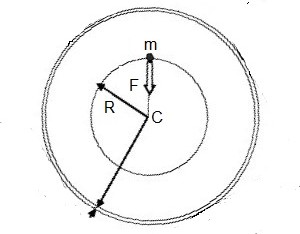 |
The Paradox of Newtonian Gravitation is in the fact that, according to the above calculations, any test mass $\,m\,$ anywhere
in the universe is being attracted (with a force $\,F\,$) towards the center $C$ of a (spherical) coordinate system, which is also
an arbitrary point in the universe. The paradox can be derived in a much simpler way by employing two well known results in gravity
theory. Both are a consequence of Newton's Shell theorem [41]. The first result
is that the force upon a test mass inside a hollow sphere is exactly zero. The second result is that the force upon
a test mass outside a massive sphere is the same as the force towards a point at the center of the sphere with the total mass
of the sphere concentrated in it. Therefore the total force is simply
$\,F = G\,m(\rho_c\cdot 4/3\pi R^3)/R^2 = 4/3\,\pi\,G\,\rho_c\,R\,m\,$ , quite in concordance with the more elaborate theory.
|
7. Solution by Simeon Albert
How can the Paradox of Newtonian Gravitation be resolved? The approach as has been employed by
Pierre-Simon Laplace [42] is to modify Newton's third law according to
formula (2) in reference [36].
$$
F = G\frac{m_1 m_2}{r^2}\exp(-\Gamma r) \qquad (4)
$$
Let us translate this into our integral (3). Remember that $\,r = R\sqrt{1+x^2+2\,xy}\,$ in there and abbreviate $\,\Gamma R = \alpha\,$.
$$
F(R) = 2\pi\,G\,\rho_c\,R\,m\int_0^\infty x^2
\left[\int_{-1}^{+1}\frac{e^{-\alpha\sqrt{1+x^2+2\,xy}}(xy+1)}{(1+x^2+2\,xy)^{3/2}} dy \right] dx
$$
Where $\,\alpha = \Gamma R\,$ is a dimensionless quantity, still dependent on the place of the test mass in the universe with respect to some origin.
In order to resolve for the paradox, the integral must be zero. The authors of the key reference have presented numerical
evidence, but they have not been able to prove this analytically. However, by employing the power of our favorite computer algebra system [8] - Brain off, computer on! - we find a straightforward shortcut to the proof that $\,F(R) = 0\,$.
g(x,alpha) := int(exp(-alpha*sqrt(1+x^2+2*x*y))*(x*y+1)/(1+x^2+2*x*y)^(3/2),y=-1..1);
F := int(g(x,alpha)*x^2,x=0..infinity);
simplify(%,assume=positive);
                                  0
The problem has become the subject of a posting at the Mathematics Stack Exchange forum (MSE for short):
Prove or disprove the equality of these two integrals [43]. And indeed there is an analytical solution. Even better, it's entirely by hand: Brain on, computer off !
The gravitational force on a test mass in a universe with uniform density is zero everywhere. However, this is only the case with "assume=positive". The paradox pops up again as soon as $\,\alpha\,$ is exactly zero.
We can see that, at a positive infinitesimal distance from $\,\alpha = 0\,$, the integral suddenly changes from $2/3$ to $0$. Thus $\,\alpha = 0\,$ or $\,\alpha \gt 0\,$ makes a hell of a difference !!
Why are we so motivated by this problem? Once more, take a look at equation (2) in the key
paper [36]. Our version of the Variable Mass Theory comes in with a twist on Laplace's modification of the law of gravitation.
It's reasonable to assume that the test mass $\,m\,$ is located near us, here and now.
If the other infinitesimal masses $\,dM = \rho_c\,dV\,$ ($V=$ volume) in the universe are present at large distances $\,r\,$ from us, as is usually the case with cosmology,
then we are looking backwards in the past $(\,-t\gt 0\,)$ and the corresponding variable masses have been smaller at that time, according to the formulas (1) and (2) in our above section 5. ($d\rightarrow r$ renamed):
$$
r = \frac{c}{H}\ln(1+z) = \frac{c}{H}\ln\left(\frac{dM_0}{dM}\right) \qquad \Longleftrightarrow \qquad
dM = dM_0\,e^{-H/c\,\cdot\, r} \qquad (5)
$$
where $H=$ (intrinsic) Hubble parameter and $c=$ speed of light in empty space. Variable Mass leads to an equivalent of Laplace's modification (4) of the law of gravitation:
$$
dF = G\frac{m\,dM}{r^2} = G\frac{m\,dM_0}{r^2} e^{-H/c\,\cdot\, r} \qquad (6)
$$
It is easily seen now that Laplace's factor must be
$$
\exp(-\Gamma\cdot r) = \exp(-H/c \cdot r) \quad \Longrightarrow \quad \Gamma = \frac{H}{c} \qquad (7)
$$
If we take $H=H_0$ equal to a common value for the "cosmic" Hubble parameter for Cepheids,
then Pierre-Simon's constant can be calculated.
# 1 megaParsec
Mpc := 3.08567758*10^22;
# Hubble parameter (2022-02-08)
H := 73.4*1000/Mpc;
# Speed of light
c := 299792458;
# Gamma
H/c;
                                         -26
                          0.7934595873 10
It turns out to be very small indeed, approximately $\,8 \times 10^{-27}\,m^{-1}$. Compare with Laplace's own estimate as mentioned in [36]: $\,\Gamma \lt 7\times 10^{-18}\,m^{-1}$.
Note. The initials L.M. in the name of the author of the awarded answer in [43] stand for Louis Marmet [44].
8. Seeliger's Paradox
Key reference for this section is Seeliger's Gravitational Paradox and the Infinite Universe [45] by Leonardo Sarasúa. Fig. 1 is copied from the paper as it is.
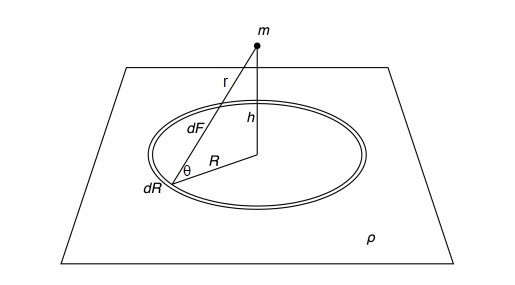
$F=$ force, $G=$ gravitational constant, $m=$ test mass, $R=$ radius, $h=$ height, $r=\sqrt{R^2+h^2}=$ distance.
The 2-D treatment in the paper will be used as a template for generalization to 3-D. The surface mass density $\rho=$ will be replaced by $\rho_c=$ volumetric mass density of cosmos. The 2-D plane in the above picture has thickness zero. For our generalization to 3-D it must be $\,dh\,$ instead. Giving a slightly but essentially different expression for the infinitesimal vertical component $dF$ of the force on the particle with mass $m\,$ as it is attracted by the plane, which has become a plate now.
$$
dF = \frac{G\,m(\rho_c\,2\pi R\,dR\,dh)}{\left(\sqrt{R^2+h^2}\right)^2}\frac{h}{\sqrt{R^2+h^2}} =
2\pi G m \rho_c\,h\,dh\frac{R\,dR}{(R^2+h^2)^{3/2}}
$$
The total force experienced by the test mass from all of the mass below it is
$$
F = 2\pi G m \rho_c \int_0^{\infty} h \left[ \int_0^{\infty} \frac{R\,dR}{(R^2+h^2)^{3/2}}\right] dh
$$
The integral between square brackets is, with $\,x=R/h\,$ and $\,u=x^2+1\,$:
$$
\int_0^{\infty} \frac{R\,dR}{(R^2+h^2)^{3/2}} = \frac{h^2}{h^3} \frac{1}{2} \int_{x=0}^{\infty} \frac{d(x^2+1)}{(x^2+1)^{3/2}}
= \frac{1}{h} \frac{1}{2} (-2) \left[\frac{1}{\sqrt{u}}\right]_1^\infty = \frac{1}{h}
$$
Giving for the total force as experienced by our test mass an infinite outcome.
$$
F = 2\pi G m \rho_c \int_0^{\infty} h\cdot\frac{1}{h} dh = \infty
$$
Minus another infinite outcome if the mass of the universe at the other side (above it) is taken into account.
Therefore the total force can be anything. Which is contrary to experience.
However, let's now introduce the panacea as proposed by Laplace and Seeliger [47] and observe what happens.
$$
F = 2\pi G m \rho_c \int_{-\infty}^{+\infty} h \left[ \int_0^{\infty} \frac{e^{-\Gamma\sqrt{R^2+h^2}}R\,dR}{(R^2+h^2)^{3/2}}\right] dh
$$
With :-(brainless)-: help of MAPLE [39] we see that the outcome is zero again,
as desired and required. Physical truth should not depend upon the way you look at it.
h*int(R*exp(-Gamma*sqrt(R^2+h^2))/(R^2+h^2)^(3/2),R=0..infinity);
f(h) := simplify(%,assume=positive);
int(f(h),h=-infinity..infinity);
                                      0
It must be possible again to do this with Brain on, computer off.
Define $\,I\,$ as the above integral:
$$
I = \int_{-\infty}^{+\infty} h \left[ \int_0^{\infty} \frac{e^{-\Gamma\sqrt{R^2+h^2}}R\,dR}{(R^2+h^2)^{3/2}}\right] dh \\
u = \sqrt{R^2+h^2} \quad ; \quad v = \frac{h}{\sqrt{R^2+h^2}} \quad ; \quad h = uv
\quad ; \quad du\,dv = \frac{\partial(u,v)}{\partial(R,h)}dR\,dh = \left| J \right| dR\,dh
$$
From the picture we see that $\,u=r\,$ and $\,v=\sin(\theta)\,$,
giving the integration bounds $\,0\le u \lt\infty\,$ and $\,-1\le v \le +1\,$.
$$
\left| J \right| = \begin{vmatrix} \partial u/\partial R & \partial u/\partial h \\
\partial v/\partial R & \partial v/\partial h \end{vmatrix} =
\begin{vmatrix} R/\sqrt{R^2+h^2} & h/\sqrt{R^2+h^2} \\ -Rh/(R^2+h^2)^{3/2} & 1/\sqrt{R^2+h^2} - h^2/(R^2+h^2)^{3/2} \end{vmatrix} = \frac{R}{R^2+h^2} \\
u^2 = R^2+h^2 \quad \Longrightarrow \quad R^2 = u^2-h^2 = u^2(1-v^2) \quad \Longrightarrow \quad R = u\sqrt{1-v^2} \quad \Longrightarrow \quad \left| J\right| = \frac{\sqrt{1-v^2}}{u} \\
I = \iint uv \cdot \frac{e^{-\Gamma\,u}\,u\sqrt{1-v^2}}{u^3} \left(\frac{u}{\sqrt{1-v^2}}\right)du\,dv =
\int_0^\infty e^{-\Gamma\,u}\,du \cdot \int_{-1}^{+1} v\,dv \\
\Longrightarrow \quad F = 2\pi G m \rho_c\;\int_0^\infty e^{-\Gamma\,u}\,du \cdot \int_{-1}^{+1} v\,dv = 0 \qquad (8)
$$
because
$$
\left(\int_0^\infty e^{-\Gamma\,u}\,du =
-\frac{1}{\Gamma}\left[e^{-\Gamma\,u}\right]_{u=0}^\infty = \frac{1}{\Gamma}\right)
\; \times \; \left(\int_{-1}^{+1} v\,dv = \frac{1}{2} \left[v^2\right]_{v=-1}^{+1}=0\right) = 0
$$
The physical meaning of $\,1/\Gamma=c/H\,$ is the speed of light in vacuum times a Hubble time. Which in some circles is called the size of the Observable universe [46].
9. E = mc2 via Mach
Key reference is the book Origin of Inertia [50].
In Amitabha's book, the Gravitational constant is allowed to vary, according to the following formula:
$$
G = G_0\exp\left(-\frac{\kappa}{c}r\right) \qquad (5.6)
$$
This is contrary to the Variable Mass Theory, where $G$ is a constant of nature and all (elementary particle rest) mass is varying, according to our own formula in this paper:
$$
dM = dM_0\exp\left(-\frac{H}{c}r\right) \qquad (5)
$$
It is thus seen that $\,\kappa\,$ in the above (5.6) is precisely the Hubble parameter $\,H\,$, as is noticed in the book [50] too: equation (6.12).
Let reading be resumed at 9.3 A Concept of Potential Energy in an Infinite Universe.
Quote: If we consider the universe to be quasistatic, with the velocity and acceleration of all objects small,
it may be possible to derive a concept of potential energy. When a particle is brought from infinity to a point at a distance $\,r\,$ from another particle, with the velocity and acceleration being infinitesimally small, it is possible to [ .. ] estimate the work done, as shown below. All of the mathematics is repeated here because there might be typos in the orginal. And our approach, with Variable Mass (VM), is anyway different.
List of symbols: $E=$ (potential) energy, $G=$ Gravitational constant, $m=$ test mass here and now, $dM=$ infinitesimal Variable Mass somewhere in the universe, $r=$ radius as redefined below, $x=$ distance between $m$ and $dM$. Furthermore $\Gamma=H/c=$ Laplace's constant, with $H=$ Hubble parameter and $c=$ speed of light in vacuum, as has been derived in section 7 formula (7). Finally, $\bf E_1$ is the so-called Exponential integral [51]. In order to avoid confusion, minus signs are inserted on the left, not on the right hand side. Our equation (5) is employed again.
$$
- dE = \int_r^\infty \frac{G\,m\,dM}{x^2}\,dx = G\,m\,dM_0 \int_r^\infty \frac{\exp(-\Gamma x)}{x^2}\,dx
\\ = G\,m\,dM_0\left[-\left.\frac{\exp(-\Gamma x)}{x}\right|_{x=r}^\infty
- \Gamma \int_r^\infty \frac{\exp(-\Gamma x)}{x}\,dx\right] \\
= G\,m\,dM_0 \left[\frac{\exp(-\Gamma r)}{r} - \Gamma E_1(\Gamma r)\right]
\quad \mbox{with} \quad E_1(x) = \int_x^\infty \frac{\exp(-t)}{t}\,dt
$$
Using the above formulation, the potential energy of a particle with mass
$\,m\,$ due to the matter of the universe contained in a spherical shell of radius $\,r\,$ and
thickness $\,dr\,$, with the particle at its centre, is with $\rho_c=$ mean mass density in $\,dM_0 = \rho_c\,4\pi r^2\,dr\,$ and $\,\xi=\Gamma r\,$:
$$
- dE = G\,m \left[\frac{\exp(-\Gamma r)}{r} - \Gamma E_1(\Gamma r)\right]\rho_c\,4\pi r^2\,dr \\
- E = 4\pi\,G\,m\,\rho_c \int_0^\infty \left[\,r\exp(-\Gamma r) - \Gamma r^2 E_1(\Gamma r)\,\right]\,dr \\ =
\frac{4\pi\,G\,m\,\rho_c}{\Gamma^2}\left[ \int_0^\infty \xi\exp(-\xi)\,d\xi - \int_0^\infty \xi^2 E_1(\xi)\,d\xi\right]
$$
Two integrals:
$$
\int_0^\infty \xi\exp(-\xi)\,d\xi = - \left.\xi\exp(-\xi)\right|_0^\infty + \int_0^\infty \exp(-\xi)\,d\xi = 1 \\
\int_0^\infty \xi^2 E_1(\xi)\,d\xi = \int_0^\infty E_1(\xi)\,d\left(\frac{1}{3}\xi^3\right) =
\frac{1}{3}\left[ \underbrace{ \left. E_1(\xi)\,\xi^3\right|_{\xi=0}^\infty }_0
+ \int_0^\infty \xi^3\cdot\frac{\exp(-\xi)}{\xi}\,d\xi\right]
$$
The first term is zero because of the Cauchy-Schwarz inequality [52]:
$$
\left[\int_\xi^\infty \frac{\exp(-t)}{t}\,dt\right]^2 \le \int_\xi^\infty \exp(-t)^2\,dt \;\cdot \int_\xi^\infty \frac{dt}{t^2} =
\frac{1}{2} \exp(-2\xi) \cdot \frac{1}{3\,\xi^3} \quad \Longrightarrow \\ 0 \le E_1(\xi) \le \frac{\exp(-\xi)}{\sqrt{6\,\xi^3}}
\quad \Longrightarrow \\ 0 \le E_1(\xi)\,\xi^3 \le \frac{\sqrt{\xi^3/6}}{\exp(\xi)} =
\frac{1/\sqrt{6}}{1/\sqrt{\xi^3}+1/\sqrt{\xi}+\sqrt{\xi}/2+\sqrt{\xi^3}/6+\cdots}
$$
And the last term is
$$
\int_0^\infty \xi^3\cdot\frac{\exp(-\xi)}{\xi}\,d\xi =
\int_0^\infty \xi^2\,e^{-\xi}\,d\xi = \left.-e^{-\xi}\,(\xi^2+2\xi+2)\,\right|_{\xi=0}^\infty = 2
$$
$$
\Longrightarrow \quad - E = \frac{4\pi\,G\,m\,\rho_c}{\Gamma^2}\left[ 1 - \frac{2}{3} \right] =
\frac{4\pi}{3} \frac{G\,m\,\rho_c\,c^2}{H^2} = \frac{4\pi}{3} \frac{G\rho_c}{H^2}mc^2
$$
There is a statement in footnote $\tiny 11$ at page 134 of the book [50]:
It is still more interesting to note that if we take the inclination effect $\,f(\theta)=\cos(\theta)\,$, $\chi = 4/3\,\pi\,$
and the potential energy of a particle with mass $\,m\,$ is exactly equal to $\,- m c^2\,$, which implies that the total energy content of the universe is nil, which is the well-known Zero-energy universe hypothesis [53].
$$
\frac{4\pi}{3} \frac{G\rho_c}{H^2}mc^2 = mc^2 \quad \Longrightarrow \\
H^2 = \frac{4\pi}{3}G\rho_c \quad \mbox{or} \quad H = \sqrt{\frac{4\pi}{3}G\rho_c} \qquad (9)
$$
Formula (9) has been our favorite for some time. However, it might not be the last word. Remember that we consider the universe to be quasistatic, with the velocity and acceleration of all objects small. Which might turn out too much of a restriction in the end.
10. Pioneer Anomaly
The Pioneer anomaly [48] is an extremely small acceleration towards the Sun, of $(8.74 \pm 1.33)\times 10^{-10}\mbox{ }m/s^2$.
Previously proposed explanations include: The magnitude of the Pioneer effect is numerically quite close to the product [ .. ] of the speed of light [ .. ] and the Hubble constant [ .. ], ipse est $a_P \approx cH$. Wikipedia proceeds with: hinting at a cosmological connection, but this is now believed to be of no particular significance. Of no particular significance? According to formula (8) we have
$$
F = 2\pi G m \rho_c \left(\int_0^\infty e^{-\Gamma\,u}\,du =
-\frac{1}{\Gamma}\left[e^{-\Gamma\,u}\right]_{u=0}^\infty = \frac{1}{\Gamma}\right)
\; \times \; \left(\int_{-1}^{+1} v\,dv = \frac{1}{2} \left[v^2\right]_{v=-1}^{+1}=0\right)
$$
where $G=$ Gravitational constant, $m=$ mass of test particle, $\rho_c=$ density (mass/volume) of cosmos here and now, $H=$ (intrinsic) Hubble parameter, $c=$ speed of light in empty space.
Some people think that a density $\rho_c$ of matter in the universe is not a meaningful concept. One reason is that exist huge irregular (fractal) structures out there. How to define an "infinitesimal" volume then in a sensible way? Let's have a quote from The Case for a Hierarchical Cosmology [49] by Gérard de Vaucouleurs.
I have discussed on several occasions since 1953 the growing evidence for a Local Supercluster (23-25), encompassing the majority of the nearby galaxies and groups with a center approximately in or near the Virgo cluster. The influence of this supercluster on galaxy counts can be detected at least down to m = 16 in the northern galactic hemisphere (26). Our Galaxy is in an outlying location, in our Local Group, near the southern edge of the system.
Such an extreme case would possibly be covered by the following thought experiment.
Suppose that matter is at one side of the test particle and calculate an upper bound for the anomalous acceleration $a_P$, by modifying the above equation (8), for example as follows.
$$
F = m.a_P = 2\pi G m \rho_c \frac{1}{\Gamma} \quad \mbox{with} \quad \Gamma = \frac{H}{c}
$$ $$
a_P = 2\pi G \rho_c \frac{c}{H} = \frac{c}{H}\frac{3}{2}\left(\frac{4\pi}{3}G\rho_c\right) =
\frac{3}{2}\frac{c}{H}H^2 = \frac{3}{2}c H
$$
where use has been made of equation (9) for the Hubble parameter as derived in the previous section.
Calculation details:
# Speed of light
c := 299792458;
# 1 megaParsec
Mpc := 3.08567758*10^22;
# Hubble parameter (2022-02-08)
H := 73.4*1000/Mpc;
# Pioneer Anomaly upper bound
3/2*H*c;
Resulting in a value $10.69688870\times 10^{-10}\mbox{ }m/s^2$. Indeed the observed acceleration of $a_P = (8.74\pm 1.33)\times 10^{-10}\mbox{ }m/s^2$ is below this upper bound.
Conflicts of Interest: The author declares no conflicts of interest.
Funding: This research received no external funding.
11. References
- https://github.com/orgs/a-cosmology-group/discussions/344
- https://en.wikipedia.org/wiki/Eric_Lerner
- https://www.amazon.nl/Big-Bang-Never-Happened-Refutation/dp/067974049X
- https://en.wikipedia.org/wiki/Jayant_Narlikar
- https://en.wikipedia.org/wiki/Russell%27s_paradox
- https://en.wikipedia.org/wiki/Actual_and_potential_infinity
- https://medium.com/@petergleeson1/there-is-no-universe-cec835dc575f
- https://en.wikipedia.org/wiki/Carl_Friedrich_Gauss
- https://cpb-us-w2.wpmucdn.com/wp.towson.edu/dist/d/714/files/2019/01/verdictSpacetimeGPB-12njkd0.pdf
- https://en.wikipedia.org/wiki/Flatness_problem
- https://en.wikipedia.org/wiki/Horizon_problem
- https://en.wikipedia.org/wiki/Magnetic_monopole
- https://en.wikipedia.org/wiki/Manifold
- https://en.wikipedia.org/wiki/Solid_mechanics
- https://math.stackexchange.com/questions/3590072/applications-of-manifolds-not-embedded-in-euclidean-space
- https://en.wikipedia.org/wiki/Minkowski_space
- https://web.maths.unsw.edu.au/~norman/papers/IntelligentDesignhtml/IntelligentDesign1.htm
- https://www.conspiracyoflight.com/Spacetime.html
- http://www.alternatievewiskunde.nl/einstein/relativity-reexamined_compress.pdf
- https://en.wikipedia.org/wiki/Non-Euclidean_geometry#Discovery_of_non-Euclidean_geometry
- https://en.wikipedia.org/wiki/Models_of_non-Euclidean_geometry
- https://math.stackexchange.com/questions/1951863/non-euclidean-geometrical-algebra-for-real-times-real
- https://en.wikipedia.org/wiki/Chronology_of_the_universe
- Hans Jörg Fahr, Mit oder ohne Urknall Das ist hier die Frage
2. Auflage, Sachbuch, Springer Spektrum, ISBN978-3-662-47711-3
- https://bigthink.com/starts-with-a-bang/
- https://en.wikipedia.org/wiki/Particle_Fever
- https://www.youtube.com/watch?v=_oa71iB_Z4Q
- https://www.lppfusion.com/censored-papers-demolish-the-big-bang-hypothesis/
- https://en.wikipedia.org/wiki/Olbers%27_paradox
- https://www.haltonarp.com/articles/intrinsic_redshifts_in_quasars_and_galaxies.pdf
- https://mindmatters.ai/2022/08/james-webb-space-telescope-shows-big-bang-didnt-happen-wait/
- https://adsabs.harvard.edu/full/1993ApJ...405...51N
FLAT SPACETIME COSMOLOGY: A UNIFIED FRAMEWORK FOR INTERGALACTIC REDSHIFTS
Jayant Narlikar and Halton Arp. The Astrophysical Journal 405: 51-56, 1993 March 1
- https://nl.wikipedia.org/wiki/Halton_Arp
- https://en.wikipedia.org/wiki/Redshift
- https://math.stackexchange.com/questions/1867464/additive-functions-and-measure-theory
- https://www.ias.ac.in/article/fulltext/reso/021/05/0447-0452
- https://en.wikipedia.org/wiki/Amitabha_Ghosh_(academic,_born_1941)
- https://en.wikipedia.org/wiki/Gravitational_constant
- https://en.wikipedia.org/wiki/Spherical_coordinate_system
- https://en.wikipedia.org/wiki/Maple_(software)
- https://en.wikipedia.org/wiki/Shell_theorem
- https://nl.wikipedia.org/wiki/Pierre-Simon_Laplace
- https://math.stackexchange.com/questions/4575165/prove-or-disprove-the-equality-of-these-two-integrals
& http://www.alternatievewiskunde.nl/cosmology/Simeon.htm (backup)
- http://www.marmet.org/louis/
- https://progress-in-physics.com/2018/PP-54-11.PDF
- https://en.wikipedia.org/wiki/Observable_universe
- https://independentphysics.com/seeliger-paradox-newtonian-cosmology/
- https://en.wikipedia.org/wiki/Pioneer_anomaly
- http://www.alternatievewiskunde.nl/cosmology/ACG_refs/de_Vaucouleurs.pdf
- Amitabha Ghosh, Origin of Inertia. Extended Mach's Principle and Cosmological Consequences.
First Published 2000 by Apeiron. 4405, rue St-Dominique, Montreal, Quebec H2W 2B2 Canada. ISBN 0-9683689-3-X
- https://en.wikipedia.org/wiki/Exponential_integral
- https://en.wikipedia.org/wiki/Cauchy%E2%80%93Schwarz_inequality
- https://en.wikipedia.org/wiki/Zero-energy_universe