Definition of finite elements (Ciarlet)
The definition as worded in the question may be the (standard?) mathematical point of view.
But the engineering point of view may be quite different from this, as exemplified for example in:

From the first chapter of the book, called
The Standard Discrete System, we have the
following pictures:
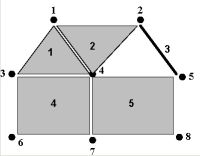
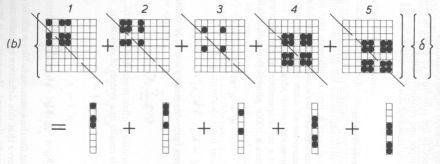
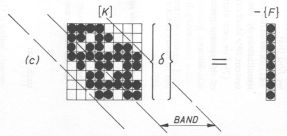
As quoted from page 10 in the book: This general assembly process can be found to be the common
and fundamental feature of all finite element calculations and should be well understood by the reader.
With the Finite Difference Method / Finite Volume Method (FDM/FVM) equations are assembled
row by row. Such in sharp contrast with the Finite Element Method (FEM), where
the equations are assembled matrix by matrix, several pieces of a row at a time.
Thus with FDM/FVM, a stencil/finite volume around a nodal point (usually the point in the middle)
gives one complete equation for that point, while, with FEM, a finite element gives only a piece
of an equation for every nodal point of the element:
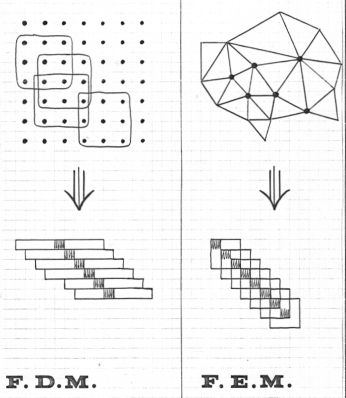
There are other cultural differences, not at all an exhaustive list here:
- FDM stencils (e.g. five point stars) may easily overlap each other; the same for finite volumes
Finite Elements usually are contiguous; they have only nodal points and/or edges in common
- regular grids are typical for FDM/FVM
unstructured grids are typical for FEM
- solving FDM/FVM equations is preferably done with iterative methods (e.g. Gauss-Seidel)
solving FEM equations is preferably done with direct methods (e.g. Gaussian elimination)
though nowadays practice seems to converge to employing the best of both worlds.
I said "cultural", because, in at least two
test
cases,
it can be claimed that the assembly procedure actually is the only difference between a Finite Element and a Finite Volume approach for the same problem.