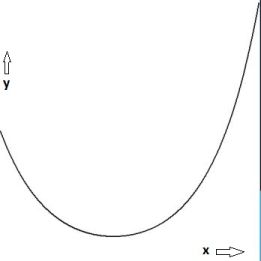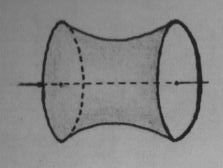
Boundary conditions. Indeed, given two fixed points in plane, we can hang catenaries of different length. Mathematically, this is expressed by $\;y(x) = A\cosh(Bx+C)\;$ with three constants $\,(A,B,C)$ . Apart from the two fixed points, this enables the length to become an additional degree of freedom.
The situation is different with the catenoid. Instead of three constants $\,(A,B,C)\,$ we have only two of these : $(a,b)$ . A physical consequence is that there is only one soap film between two rings:
Mathematics please. So let's try to solve for $\,(a,b)$ , given the fixed points $\,(x_1,y_1),(x_2,y_2)$ :
$$
\begin{cases}y_1 = a\,\cosh(x_1/a+b) \\ y_2 = a\,\cosh(x_2/a+b) \end{cases}
$$
Two equations with two unknowns.
Doing it by hand seems to be hopeless. Feeding it into my favorite computer algebra system (MAPLE) results in a two page long expression that the OP doesn't want to know, I think.
Anyway, the length $L$ of the soapfilm catenary can be expressed in the solutions
$\,(a,b)\,$ and the abscissae of the end-points, therefore it is no longer a degree of freedom:
$$
L = \int_{x_1}^{x_2} \sqrt{1+\left[y'(x)\right]^2}\,dx =
\int_{x_1}^{x_2} a\sqrt{1+\left[\sinh(x/a+b)\right]^2}\,d(x/a+b) \\
= \int_{x_1/a+b}^{x_2/a+b} a\cosh(u)\,du = a\sinh(x_2/a+b)-a\sinh(x_1/a+b)
$$
Brute force.
Numerical methods may offer a panacea where analytical methods fail. For ease of the calculations,
replace $\,b\,$ by $\,(-p/a)\,$ - should have done this from the beginning - and consider instead:
$$
\begin{cases}y_1 = a\,\cosh((x_1-p)/a) \\ y_2 = a\,\cosh((x_2-p)/a) \end{cases}
$$
Then $\,x = p\,$ is the place where the catenary has its the minimum $\,a$ .
It follows that, without loss of generality (??) : $x_1 \le p \le x_2\,$ and $\,0 < a \le \min(y_1,y_2)\,$ .
With the home-made tools I have at my disposal, I can easily make an isoline chart / contour plot of the place
where the following functions are zero:
$$
\begin{cases} \color{red}{f(p,a) = a\,\cosh((x_1-p)/a)-y_1 = 0} \\
\color{green}{g(p,a) = a\,\cosh((x_2-p)/a) - y_2 = 0} \end{cases}
$$
Now determine numerically the intersection point of the green and red isolines and you're done.
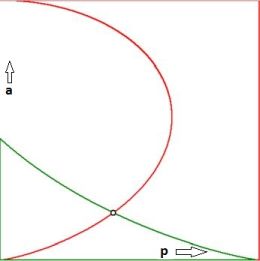
An example with $(x_1,y_1) = (1,1)$ and $(x_2,y_2) = (2,2)$ results in the following values of $(p,a)$:
1.43600867678959E+0000 1.82608695652174E-0001And the catenary of the catenoid can be sketched with these values, at last: