    1 1.00000000000000E+0000 >  3.18309886183791E-0001
0
    2 5.00000000000000E-0001 >  3.18309886183791E-0001
0
    3 3.33333333333333E-0001 >  3.18309886183791E-0001
0 2
    4 3.53553390593274E-0001 >  3.18309886183791E-0001
0 1
    5 3.23606797749979E-0001 >  3.18309886183791E-0001
0 1 2
    6 3.33333333333333E-0001 >  3.18309886183791E-0001
0 4 5
    7 3.20997086245352E-0001 >  3.18309886183791E-0001
0 1 2
    8 3.26640741219094E-0001 >  3.18309886183791E-0001
0 1 2 3
    9 3.19931693507980E-0001 >  3.18309886183791E-0001
5 6 7 8
   10 3.23606797749979E-0001 >  3.18309886183791E-0001
3 4 5 6 7
   11 3.19394281060558E-0001 >  3.18309886183791E-0001
4 5 6 7 8 9
   12 3.21975275429689E-0001 >  3.18309886183791E-0001
1 2 3 4 5 6
   13 3.19085761944568E-0001 >  3.18309886183791E-0001
3 4 5 6 7 8
   14 3.20997086245352E-0001 >  3.18309886183791E-0001
0 1 2 3 4 5 6
   15 3.18892407783521E-0001 >  3.18309886183791E-0001
0 1 2 3 11 12 13 14
   16 3.20364430967688E-0001 >  3.18309886183791E-0001
0 1 2 3 4 13 14 15
   17 3.18763277866454E-0001 >  3.18309886183791E-0001
5 6 7 8 9 10 11 12
   18 3.19931693507980E-0001 >  3.18309886183791E-0001
2 3 4 5 6 7 8 9 10
   19 3.18672778564237E-0001 >  3.18309886183791E-0001
2 3 4 5 6 7 8 9 10
   20 3.19622661074983E-0001 >  3.18309886183791E-0001
3 4 5 6 7 8 9 10 11 12
   21 3.18606904753685E-0001 >  3.18309886183791E-0001
0 1 2 3 15 16 17 18 19 20
   22 3.19394281060558E-0001 >  3.18309886183791E-0001
0 1 2 3 4 5 6 7 8 9 10
   23 3.18557468338846E-0001 >  3.18309886183791E-0001
7 8 9 10 11 12 13 14 15 16 17
   24 3.19220732314183E-0001 >  3.18309886183791E-0001
4 5 6 7 8 9 10 11 12 13 14 15
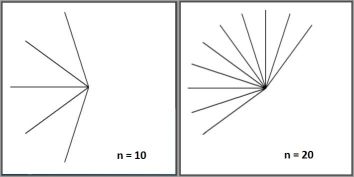
Two snapshots should clarify the pattern in the subsets that do the job:
So it seems that, without too much loss of generality, we can conjecture that:
$$
\left|\sum_{z\in S} z\right| = \left|\sum_{k=0}^{n/2-1} \frac{1}{n} e^{i\cdot k\,2\pi/n}\right|
$$
The sum of a geometric series is recognized herein:
$$
\sum_{z\in S} z = \frac{1}{n} \frac{1-r^{n/2}}{1-r} \quad \mbox{with} \quad r = e^{i\cdot 2\pi/n}
$$
Hence:
$$
\left|\sum_{z\in S} z\right| = \frac{1}{n} \left|\frac{1-e^{i\cdot 2\pi/n\cdot n/2}}{1-e^{i\cdot 2\pi/n}}\right| =
\frac{1}{n} \left|\frac{2\cdot i}{e^{i\cdot \pi/n}\left(e^{-i\cdot \pi/n}-e^{i\cdot \pi/n}\right)\cdot i}\right| =
\frac{\pi/n}{\sin(\pi/n)}\frac{1}{\pi}
$$
And a well known limit tells us that
$$
\lim_{n\to\infty} \left|\sum_{z\in S} z\right| = \frac{1}{\pi}
$$
in concordance with the numerical experiments.
Don't get me wrong. The above is only a sketch of a proof. Quite some technicalities remain to be filled in.
The main part to be proved is: why should this very special case be relevant for the general case of arbitrary $\,z_k$ ?
(Though it's not uncommon that solutions of high symmetry are relevant for finding extreme values in a more general setting)