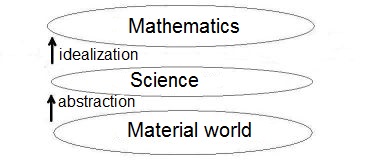
We would like to conjecture that two important mechanisms are involved
with a mathematical description of the material world:
- Abstraction, giving rise to Science
- Idealization, giving rise to Mathematics
Schematically:
Abstraction
Etymology. Perfect passive participle of abstraho ("draw away
from"). Certain properties of the whole thing are preserved in the process
of Abstraction:
We shall argue that Abstraction is not a mathematical but rather a physical
activity. It's already done by our senses. Our eyes can see the light, as it
is casted back from a piece of paper. The same piece of paper can be felt by
our fingertips. And when it is crumpled up, the sound of it will be heard by
our ears. But eyes cannot hear sound, fingertips cannot see light. All these
single perceptions of our senses have to work together. And even if we are not
handicapped, the end-result is still an abstraction of reality as a whole, a
part of it. None of our senses is capable, for example, to see ultraviolet
colors, as some insects probably can.
But why should attention be restricted to the creations of Nature? Why not
take a look at our own creations: human made Technology? Some cameras
are capable to "see" in the infrared domain. Our radio telescopes are even
capable to "see" the radio frequencies of far away galaxies. Far more common
and well-known everyday abstractions of reality are performed, however, with
measuring devices like rods for the abstraction of lengths, clocks for the
abstraction of time intervals. But these measuring devices have become more
and more self supporting these days. When coupled with digital computers, human
interaction is hardly needed anymore. All such apparatus make an abstraction of reality,
which is thus a physical and not a mental process.
Idealization
This raises an obvious question: where does"real" mathematics start
then? Answer: with the next step: Idealization. Idealization could
be characterized as the true mathematical activity. Idealization is where
imagination and phantasy come in. And it turns out that infinity
is often a keyword accompanying this process.
Many challenging idealizations are found in theories of Physics.
In "The Theory of Heat Radiation" by Max Planck, Wien's Displacement Law
(chapter III) can only be derived under the following conditions: if the black
radiation contained in a perfectly evacuated cavity with perfectly reflecting
walls is compressed or expanded adiabatically and infinitely slowly. Idealized
Carnot engines are used in Thermodynamics for defining that stunning but
indispensable quantity, called Entropy. And the list goes on and on. How about
ideal, frictionless movement in mechanics? How about ideal pendulums, which can
only exist through a sine with (almost) zero amplitude. As soon as physicists
have devised their mathematical model, then it can be said that idealization
has been accomplished a great deal. One should become alerted as soon as the
following phrases are being uttered: "perfect", "ideal", "zero", but especially
"infinitely", like in "infinitely slow" or "infinitely thin". It can safely be
concluded that Infinities are invariably associated with Idealizations.
Concerning mathematics,
among the most classical examples of idealization, without doubt, is good old
Euclidean Geometry - where we should start to consider geometry in its
original setting: classical Greek philosophy. Remember utterings like: a point
has no size, a line is infinitely thin, parallel lines intersect at infinity.
The concept of an irrational number wouldn't have emerged if Euclidean
geometry hadn't been there in the first place.
So what is $\sqrt{2}$ ? It's an idealization. It's an idealization of numerous
abstractions, abstractions of numbers like $1.414213562373$ or $1.14$ or $99/70$ ,
as measured for example with a rod when trying to determine the length of
the hypotenuse of a right triangle with legs of length $1$ meters.
$\sqrt{2}$ doesn't exist in the real world. But neither does an ideal triangle.
All you can have in reality is "wooden triangles with legs not exactly $1$ meters and a
main angle not exactly right".
A mathematics with such triangles would be
extremely clumsy, so we are happy that idealized triangles can be imagined.
It may be concluded that your "fixed length" is an idealization, an illusion
as well. This resolves the "paradox" that a "fixed length" could not be
represented by the infinitely many decimals of an irrational number. Both
the length and the number are not real.