Wrong limits do not commute (sci.math)
======================================

An excercise, in mathematics, always consists of two parts: a question
and an answer. Some teachers think that they are smart by asking wrong
questions and nevertheless expect right answers to those questions.
But, of course, the "right" answer to a wrong question is still wrong.

Especially with limits, wrong questions are imposed upon students, in
order to demonstrate, for example, that: limits do not always commute.

Example 1, by Horand Gassmann, from "Why does everyone do it?":

   f_n(x) = 1 if n <= x < n+1
          = 0 otherwise

   Then int_{-infinity}^{+infinity} f_n(x)dx = 1, and hence
   lim{n->infinity}[int...] = 1, as well, while
   lim{n->infinity} f_n(x) = 0 for every x, and so
   int_{-infinity}^{+infinity} [lim...] = 0.

Let's analyse this. We shall first unravel the meaning of these limits:

   int_{-infinity}^{+infinity} f_n(x)dx = lim   int_(-L)^(+L)  f_n(x)dx
                                          L->oo

Therefore what's really going on is the following (n natural, L real):

   lim   lim   int_(-L)^(+L)  f_n(x)dx ( = lim   1 = 1 )
   n->oo L->oo                             n->oo

   lim   lim   int_(-L)^(+L)  f_n(x)dx ( = lim   0 = 0 )
   L->oo n->oo                             L->oo

Where the answer between parentheses is the one expected by your maths
teacher. Now Horand himself has published a picture that is associated
with this little problem:
                                 --------
                                 :      :
---------------------^-----------  ^   ------^---------------- f_n
                      L          n  L  n+1    L

Apart from the limits - as long as we are in the finitary domain, then
it's obvious that there exist the following possibilities for L and n:

   L < n  ;  L = n  ;  n < L < n+1  ;  n+1 = L  ;  n+1 < L

Now Horand says that it's possible to "fix" n and let L go to infinity
or that it's possible to fix L and let n go to infinity. _I_ say that
such a "fixed" real L or natural n is an undefined concept. A real is
just a real and there's nothing "fixed" or "variable" with it. We have
to live wit the fact that _both_ n and L approach limiting values and
in _whatever_ fashion. So what is the proper way to express this idea?
With other words: what would have been the _right question_ belonging
to this excercise? The following is my proposal:

     lim           int_(-L)^(+L)  f_n(x)dx
     min(n,L)->oo

And now the _proper_ the answer is that this limit: does not exist. Or
rather that it has a value between 0 and 1, not by coincidence the two
extremes found by Horand's students (at least those who got an 'A' for
their exam). In this case two limits do not commute and the associated
right questioned limit does not exist. Hmm, would that be systematical?

Example 2, by Horand Gassmann, from "Why does everyone do it?":

   Let g_n(x) =      2.n^2.x   if   0    <= x < 1/(2n)
              = 2n - 2.n^2.x   if 1/(2n) <= x < 1/n
              = 0 everywhere else.

   These functions are triangular, and they all disappear outside of
   [0,1], so I can compute int_0^1{g_n(x) dx} = 1 for every n.
   And again, for every x, lim{n->infinity g_n(x) = 0.
   So again, the limit and the integration can't be interchanged.

Sure,  g_n(x) = 0 , sure. It's not the first time I've seen infinities
suddenly disappear by mainstream mathematician's "ingenuity".
As Mr. Gassmann has admitted, this is a proper picture of the problem:
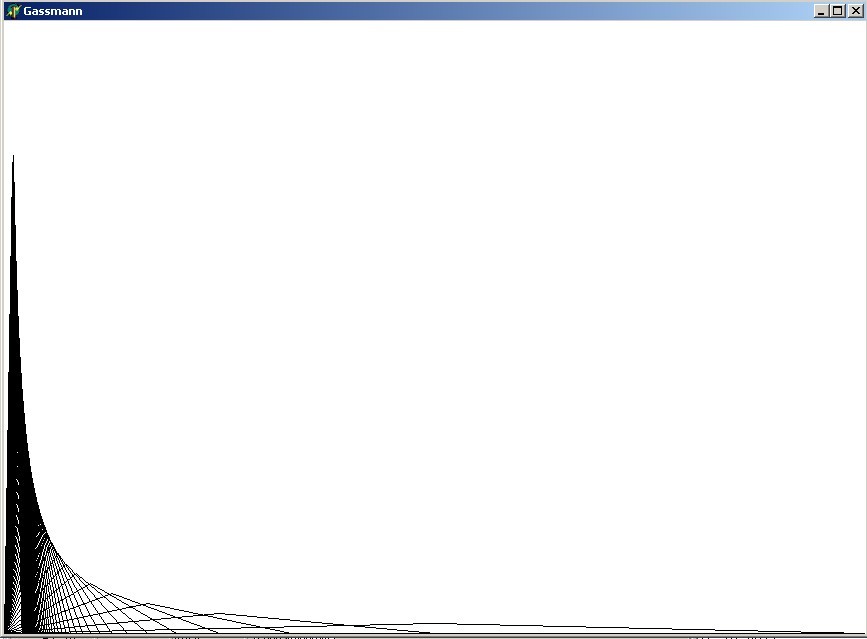
We see that the function g_n(x) becomes a sharp peak at x=0 for n->oo
and that, geometrically, it certainly not disappears or becomes zero.
The vemin is again in the false doctrine that it would be possible to
"fix" x and let n go to infinity. Again, HdB says that such a "fixed"
real x is an _undefined_ concept. A real is just a real and there's
nothing "fixed" or "variable" with it. Such is even more obvious with
the present function  g_n(x) , where x and n are clearly intermixed,
by definition. So we _can_ have: 0 <= x < 1/(2n) , 1/(2n) <= x < 1/n ,
1/n <= x , and nothing prevents us from going to limits _while_ this
is the case. If we just do this, then what we get is what physicists
know as a delta function:

  delta(x) = 0   for  x <> 0
           = any  for  x = 0  ;  integral_(-oo)^(+oo) delta(x) dx = 1

It's easy to see that:  lim   g_n(x) = delta(x)
                         n->oo

Whatever definition might be the "right" one, a delta function roughly
speaking is just a very large peak around x = 0 with area normed to 1.
With the finitary domain in mind, there is no problem in understanding
what delta functions actually are (even if they are a bit beyond x=0).

Note that, in this case, it's _not_ even the wrong question. It's just
that professors expect a wrong answer from their students. The second
answer is wrong, namely, and the first one is right:

   lim   [ int_0^1 g_n(x) dx ] = 1 = int_0^1 [ lim   g_n(x) ] dx
   n->oo                                       n->oo

Example 3, from a (hypothetical, I've made it up) textbook.

                x^2 - y^2
   Let F(x,y) = ---------  .
                x^2 + y^2

To avoid trouble with the mainstreamers, we could define F at (x,y) =
(0,0) as the mean value  F(0,0) = 0 . As far as I'm concerned myself,
I'd rather define F(0,0) as 0/0 = anything. And in view of the sequel
that anything is restricted to values between -1 and +1. Proceeding:

                  x^2 - y^2                    x^2/y^2 - 1
   lim   ( lim    --------- ) = lim   ( lim    ----------- ) = - 1
   x->oo   y->oo  x^2 + y^2     x->oo   y->oo  x^2/y^2 + 1

                  x^2 - y^2                    1 - y^2/x^2
   lim   ( lim    --------- ) = lim   ( lim    ----------- ) = + 1
   y->oo   x->oo  x^2 + y^2     y->oo   x->oo  1 + y^2/x^2

So again, according to the textbook, the limits do not commute.

                 x^2 - y^2            x^2
   lim  ( lim    --------- ) = lim  ( --- ) = + 1
   x->0   y->0   x^2 + y^2     x->0   x^2

                  x^2 - y^2            - y^2
   lim   ( lim    --------- ) = lim  ( ----- ) = - 1
   y->0    x->0   x^2 + y^2     y->0   + y^2

So again, according to the textbook, the limits do not commute.

Unravel the limits. We will do so by introducing polar coordinates:

   x = r.cos(phi)  ;  y = r.sin(phi)

          x^2 - y^2   r^2 ( cos^2(phi) - sin^2(phi) )
Giving   --------- = ------------------------------- = cos(2.phi)
          x^2 + y^2   r^2 ( cos^2(phi) + sin^2(phi) )

Now we can understand immediately why the professor's limits for x and
y _indeed_ do not commute ! At (x,y) = 0 , this function is _singular_
and it assumes any value between -1 and +1. And the latter is the case
everywhere else in the (x,y)-plane. So unless there is a clear path to
infinity, any value between -1 and +1 would be good enough for an 'A'.
See? The function is a circular wave, or rather the wave perpendicular
to it and has period Pi. Here is an (ASCII) contour map of it. Notice
the singularity at the origin.

                0     -1      0
                 \     |     /
                  \    |    /
                   \   |   /
                    \  |  /
                     \ | /
                      \|/
           +1 ------------------- +1
                      /|\
                     / | \
                    /  |  \
                   /   |   \
                  /    |    \
                 /     |     \
                0     -1      0

Why not ask then _proper_ questions belonging to answers? Here comes:

                x^2 - y^2
   lim        ( --------- ) = undefined (between -1 and +1)
   |(x,y)|->0   x^2 + y^2

                 x^2 - y^2
   lim         ( --------- ) = undefined (between -1 and +1)
   |(x,y)|->oo   x^2 + y^2

With other words: let the absolute value of the vector (x,y) approach
zero, or infinity, and see what happens. (Neighbourhoods and such ..)

Excercise 4.

                   x.y
   Let G(x,y) = ---------  .  I'm sure you can do this one by yourself.
                x^2 + y^2

Wrong limits do not commute. Almost dare to say now that non commuting
limits are simply .. wrong. Any counter examples are quite welcome.

Guess it's not so much superstition but merely a sense of reality that
so many people actually believe that: properly posed limits do commute.

Han de Bruijn

P.S.

Non commuting limits are thus "pure" mathematical, or artificial. The
gist of the false argument is that it is possible to make one of the
infinities _complete_ before taking the other limit. A fact of nature
is, though, that both "infinities" are a figure of speech and none of
them is ever "completed" first. So we have to analyze what happens if
both "infinities" are replaced by very large, but nevertheless FINITE
quantities. And then observe what happens if BOTH quantities approach
infinity, quite independent of each other.

What worries us is that such non commuting (call them nonsense) limits
are teached to our students in the common mathematics curriculum, for
the purpose of "sharpening" their brains ..