Question: Is there an energy density associated with a Gravitational Field? [5].
Yes, there is! Let us use the similarity between the gravitational and electric fields to construct a gravitational energy density term. Start by noticing how the permittivity of free space enters into the expression for $E$ : $$ E = kQ/r^2 \quad \mbox{where} \quad k = 1/(4\pi\epsilon_0) $$ is a universal constant, $Q$ is the source charge, and $r$ is radial distance from the source. The gravitational field is given by an analogous expression $$ g = GM/r^2 $$ where $G$ is a universal too, namely the gravitational constant, $M$ is the source mass. The electrical field energy density may be written in terms of $k$ as $$ u_E = \frac{1}{2}\cdot 1/(4\pi k)\cdot E^2 = E^2/(8\pi k) $$ By analogy, a candidate gravitational energy density term may now be constructed, where the minus sign is according to [5]: $$ u_G = -g^2/(8\pi G) $$ We will use Newton's law of gravitation without modification, and incorporate the energy density term described above. $$ g = GM/r^2 \quad \mbox{so that} \quad u_G = - GM^2/(8\pi r^4) $$ Integrate the above to find the gravitational energy of the entire Observable universe [3]. $$ U_G = \int_{R_O}^\infty - \frac{GM_O^2}{8\pi r^4}4\pi r^2 dr = - \frac{GM_O^2}{2}\int_{R_O}^\infty\frac{dr}{r^2} = - \frac{GM_O^2}{2R_O} $$ Substitute values from the sections 7 and 8 in the same paper [3] for mass and radius of the Observable VM universe, the formulas (11) and (13) to be precise. $$ M_O = \frac{c^3W}{2GH} \quad \mbox{and} \quad R_O = W\frac{c}{H} $$ where $c=$ speed of light in empty space, $G=$ gravitational constant, $H=$ Hubble parameter, $W=$ dimensionless number = 3.383634283. And it appears that the total energy of the gravitational Self Energy Field is minus one quarter of the mass-energy of the VM Observable universe. $$ U_G = - \frac{G}{2}\left(\frac{c^3W}{2GH}\right)^2\frac{H}{W.c} = - \frac{c^5.W}{8GH} = - \frac{1}{4}M_Oc^2 \qquad (1) $$ It is important to notice that the dimensionless constant $W$ appears in all of these formulas only as a result of integration over a region ranging from $0$ to $W$. This means that the numerical value $W$ in principle can be replaced by anything else, namely by integrating over a different region in the universe.
2. Employing the Hubble Tension
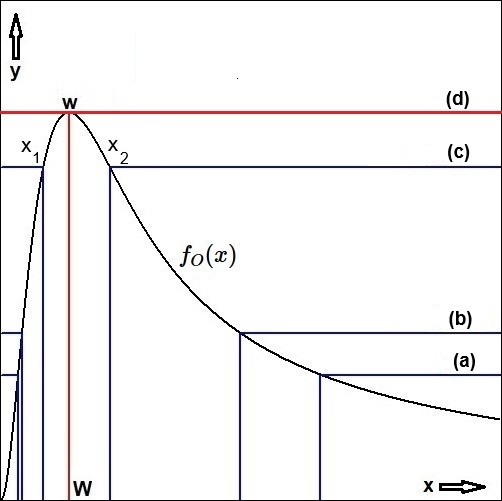
Elsewhere [3], the following formulas for the Hubble parameter $H$ have been found. $$ H^2 = \chi\,8\pi\,G\,\rho_c \quad \mbox{with} \quad \begin{cases} \chi = w & (\mbox{d}) \\ \chi = 1/3 & (\mbox{c}) \\ \chi = 1/6 & (\mbox{b}) \\ \chi = 1/8 & (\mbox{a}) \end{cases} $$ where $G=$ gravitational constant, $\rho_c=$ critical mass density of cosmos, $w=$ 0.3883945571 = dimensionless constant. The cases (a) and (b) will be ignored in the current context, leaving us with the cases (c) and (d).
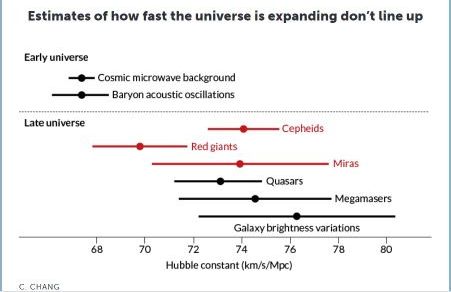
In the Variable Mass theory there is not a single value for the Hubble parameter, because $H=(2/A)$ where A is an "Age" and A can even be the age of the earth. Let us first define the Hubble parameter of the Observable universe [3] in VM: $$ H_O^2 = w.8\pi.G.\rho_c \quad \mbox{(Late universe) or (d)} $$ And a different Hubble parameter for the Cosmic Microwave Background [8] (with ΛCDM): $$ H_{CMB}^2 = \frac{1}{3}.8\pi.G.\rho_c \quad \mbox{(Early universe) or (c)} $$ Then it follows that $$ H_{CMB}^2 = \frac{1}{3w} H_O^2 \quad \Longrightarrow \quad \boxed{ H_{CMB} = \frac{1}{\sqrt{3w}} H_O } $$ Numerical values are obtained at hand of the following data.
'Hubble constant -- at 67.4 (+/- 0.5) km/sec/Mpc', NASA Science, July 22, 2018
'Hubble constant at 73.2 (+/- 1.3) km/sec/Mpc', The Astrophysical Journal Letters, February 2021
$$ H_{CMB} = \frac{1}{\sqrt{0.3883945571\times 3}} \times 73.2 = 67.8 $$ which is according to the data.
Our exercise with the Hubble tension has resulted in the following relationship between the Hubble parameter as it is needed for the Cosmic Microwave Background [8] and the critical mass density. $$ H^2 = \frac{8}{3}\pi.G.\rho_c \qquad (2) $$ The heuristics in this section has ended herewith. Forget about the numerical value of $H_{CMB}$. It is considered to be an artefact of the Big Bang theory and this value of the Hubble parameter is of no further interest for our Quasi Steady State Cosmology (QSSC). This may seem illogical at first sight, but an argument is that the value of the Hubble parameter itself is not discussed either in Origin of Inertia [6], for the cases (a) and (b).
3. CMB Temperature here and now
The mass of the Gravitational Self Energy Field does not combine with common mass. Because this means that according to (1) we would have to insert corrections $M_O := (1-1/4)M_O$. Iterating these corrections causes the Mass of the Observable universe quickly converge to zero. Which is of course nonsense. $$ \left(\frac{3}{4}\right)^N \lt 10^{-m} \quad \Longleftrightarrow \quad N \gt \frac{\ln(10)}{\ln(4)-\ln(3)}\times m \approx 8\times m $$ For example, putting $M_O := 0.001 \times M_O$ gives $N \approx 25$ iterations needed.So there must exist another mechanism for converting the self-energy of gravitation into something. That something is conjectured to be the Cosmic Microwave Background [8], according to $\,U_{CMB}+U_G=0\,$: the sum of the respective energies is zero.
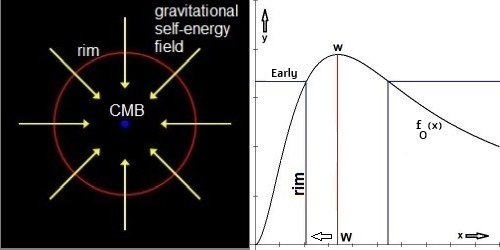
Heuristics in the above section is a confirmation that we must use the Early universe entry $\Leftarrow W$ in the above picture. With the critical mass density of the universe assumed constant, this corresponds with a smaller Hubble parameter $H=2/A$ and thus indeed with a larger age $A$. Using that Early universe entry with our integration procedure we find with (1) for the CMB:
$$
U_{CMB} = -U_G = \frac{1}{4}M_Oc^2 \quad \mbox{with} \quad M_O = \frac{c^3W}{2GH} \qquad (3)
$$
where $U=$ total energy, $M_O=$ mass of Observable universe, $c=$ speed of light in empty space, $G=$ gravitational constant, $H=$ Hubble parameter, $W=$ dimensionless constant = 2.096433787 (numerically), at the place where the Observability function [3] in VM is equal to $1/3$:
$$
f_O(x) = \frac{2-e^{-x}(x^2+2x+2)}{x} = \frac{1}{3} \quad \Longrightarrow \quad x = 2.096433787 \Leftarrow W
$$
As a second ingredient it is assumed that the CMB temperature, denoted as Θ, is proportional with cosmological redshift $(1+z)$. The redshift obeys the logarithmic formula $r=(c/H)\ln(1+z)$ - in TL (Tired Light theories) as well as in VM - and so
$$
\Theta = \Theta_0 (1+z) = \Theta_0 e^{H/c.r}
$$
where the subscript (0) denotes the CMB temperature at our place and $r=$ distance.
The Stefan-Boltzmann law [7] expressed as a formula for radiation energy density is:
$$
u_{CMB} = \frac{4}{c}\sigma \Theta^4
$$
where the constant of proportionality, $\sigma$, is called the Stefan-Boltzmann constant.
The total energy of the CMB is thus expressed by the following integral over a sphere with radius $R_O=W(c/H)$ of the Observable (VM) universe, taking $x=(H/c)r$.
$$
U_{CMB} = \int_0^{R_O} \frac{4}{c}\sigma \left(\Theta_0 e^{(H/c)r}\right)^4 . 4\pi r^2 dr
= \frac{4}{c}\sigma \mbox{ }\Theta_0^4 . 4\pi \left(\frac{c}{H}\right)^3 \int_0^W e^{4x}x^2dx \qquad (4)
$$
The integral is calculated to be
$$
II = \int_0^W e^{4x}x^2dx = e^{4W}\left(\frac{1}{4}W^2-\frac{1}{8}W+\frac{1}{32}\right)-\frac{1}{32}
$$
The end-result is found by combining (3) and (4).
$$
\Theta_0 = \left[\frac{M_Oc^2/4}{(4\sigma/c).4\pi.(c/H)^3.II}\right]^{1/4}
$$
which should give the CMB temperature at our place, while adopting the Riess value for Hubble:
W := 2.096433787;
G := 6.67408*10^(-11);
Mpc := 3.08567758*10^22;
H := 73.4; # Riess
H := H*1000/Mpc;
c := 299792458;
sigma := 5.670374419*10^(-8);
M_O := c^3*W/(2*G*H);
II := exp(4*W)*(W^2/4-W/8+1/32)-1/32;
Theta_0 := (M_O*c^2/4/(4*sigma/c*4*Pi*(c/H)^3*II))^(1/4);
Theta_0 := evalf(Theta_0);
The outcome is Θ0 = 2.7256(8) K , which (by accident or not) accurately reflects the empirical value.
4. References
- https://github.com/orgs/a-cosmology-group/discussions/344
- https://github.com/orgs/a-cosmology-group/discussions/370
- https://github.com/orgs/a-cosmology-group/discussions/377
- https://www.grc.nasa.gov/www/k-12/Numbers/Math/Mathematical_Thinking/possible_scalar_terms.htm
- https://physics.stackexchange.com/questions/326819/is-there-an-energy-density-associated-with-a-gravitational-field
- Amitabha Ghosh, Origin of Inertia. Extended Mach's Principle and Cosmological Consequences.
First Published 2000 by Apeiron. 4405, rue St-Dominique, Montreal, Quebec H2W 2B2 Canada. ISBN 0-9683689-3-X - https://en.wikipedia.org/wiki/Stefan%E2%80%93Boltzmann_law
- https://en.wikipedia.org/wiki/Cosmic_microwave_background