This paper is the third one in a series of articles about the Variable Mass theory.
Earlier publications in the VM series are: 1. Atomic Time, Orbital Time and the Variable Mass Theory and 2. The Variable Mass Theory and Gravitational Paradoxes. The main content of the first two papers is supposed to be more or less familiar to the reader.
The paper is entirely devoted to the supposed relationship between the Hubble constant and the critical mass density of the universe.
CONTENTS
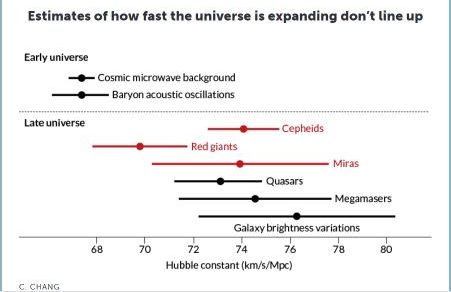
The mathematical machinery in this paper may be rather complicated, but it all rests on one basic formula in [1], namely (9). $$ \frac{m}{m_0} = \large e^{H.t} \normalsize \quad \mbox{with} \quad H = \frac{1}{A} $$ where $m=$ mass, subscript $_0=$ here and now, $H=$ (intrinsic) Hubble parameter, $t=$ atomic time. According to formula (11) in [1] the Hubble parameter is equivalent with the inverse of an age $\,A\,$, as measured in the Orbital timeframe. So there is no a priori reason why ages should be equal for the Cosmic microwave background, Red giants, Cepheids, Quasars, the Solar System, the Earth. In VM cosmology the so-called Hubble tension may be essential, instead of something that needs a remedy. This paper is about the (observable) universe as a whole. This means that the Hubble parameter is business as usual, namely $H\equiv H_0\,$, with tensions eventually, as depicted in the figure below.
Likewise it is assumed that the intergalactic medium (IGM) is so much empty that $c\equiv c_0\,$, at a cosmic scale, is the speed of light in vacuum.
Another aspect of the above formula is that distances $\,r\,$ in deep space are measured by light years, not seconds. And (atomic) time is running backwards, because we are looking into the past. This replaces the above formula by an equivalent that will be used throughout this paper, $c=$ speed of light in empty space.
$$
r = c\cdot(-t) \quad \Longrightarrow \quad \frac{m}{m_0} = \large e^{-H/c\,\cdot\,r} \normalsize \qquad (1)
$$
The cosmological redshift $z$ is intrinsic: it only depends on variable (elementary particle rest) mass. Because that is where the VM theory has been designed for:
$$
1+z=\frac{m_0}{m}=\large e^{H/c\,\cdot\,r} \normalsize \qquad (2)
$$
Variable Mass also leads to an equivalent of Laplace's modification of the law of gravitation, which is (4) combined with (7) in [2]:
$$
F = G\frac{m\,M}{r^2} = G\frac{m\,M_0}{r^2} \large e^{-H/c\,\cdot\, r} \normalsize
\quad \mbox{with} \quad \frac{H}{c} = \Gamma \qquad (3)
$$
where $F=$ force, $M=$ mass, $G=$ gravitational constant.
A third key reference is the book Origin of Inertia. Extended Mach's Principle and Cosmological Consequences [5] by Amitabha Ghosh [6].
It is noticed that our formula (3) is essentially the same formula as (2.25) in [5]. And subsequent formulas (2.25), (2.26) and (2.27) have been the subject of section 7 in [2].
2. Origin of Inertia
Let's scrutinize the Ansatz as proposed by Sciama [9], which is formula (3.2) in the book [5]. The meaning of the symbols is as usual:
$F=$ force, $G=$ Gravitational constant, $m=$ mass, $r=$ distance, $v=$ velocity, $c=$ speed of light (in empty space), $a=$ acceleration, $\rho=$ density, $H=$ Hubble parameter.
$$
F = \frac{G\,m_1 m_2}{r^2} + \frac{G\,m_1 m_2}{c^2 r} a
$$
This force has to be integrated accordingly, over a sphere with the radius of the universe. We have seen in Seeliger's Paradox, section 8 in [2], that this "radius" is given by $\,1/\Gamma=c/H\,$. The Paradox is also the reason why only the second term is considered here. We will concentrate ourselves on the acceleration term of the force, as proposed in the book.
Let reading be resumed at 9.3 A Concept of Potential Energy in an Infinite Universe.
Quote: If we consider the universe to be quasistatic, with the velocity and acceleration of all objects small,
it may be possible to derive a concept of potential energy. When a particle is brought from infinity to a point at a distance $\,r\,$ from another particle, with the velocity and acceleration being infinitesimally small, it is possible to [ .. ] estimate the work done, as shown below. All of the mathematics is repeated here because there might be typos in the orginal. And our approach, with Variable Mass (VM), is anyway different.
Acknowledgements: I am grateful to Amitabha Ghosh for his valuable
comments in the ACG discussions forum [10].
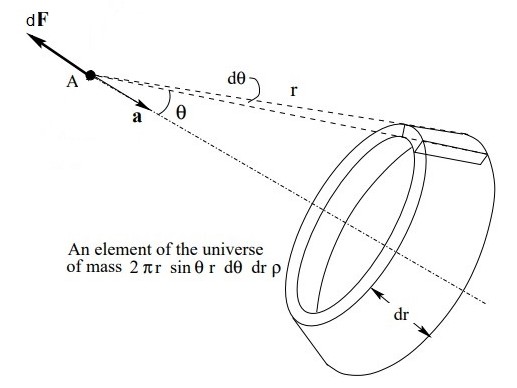
$$
dF_a = \frac{G\,2\pi r^2\,\sin(\theta)\,d\theta\,dr\,\rho\,m}{c^2\,r}a\,f(\theta)\cos(\theta)
$$
An equivalent of formula (5.1), without the VDII, is
$$
\vec{F}_a = - \vec{e}_a\frac{ma}{c^2}\int_0^\infty \chi\,G\,\rho\,r\,dr
\quad \mbox{with} \quad \chi = 4\pi\int_0^{\pi/2}\sin(\theta)\cos(\theta)f(\theta)\,d\theta
$$
If we skip all the way to (5.12) then it is motivated by the author that $\,\chi=\pi\,$, which furthermore is assumed throughout the book. We arrive at a slightly different result, though, by adopting the more simple assumption that $\,f(\theta)=\cos(\theta)\,$:
$$
\chi = 4\pi\int_0^{\pi/2}\sin(\theta)\cos^2(\theta)\,d\theta = - 4\pi\int_0^{\pi/2}\cos^2(\theta)\,d(\cos(\theta)) =
-4\pi\left[\frac{1}{3}\cos^3(\theta)\right]_0^{\pi/2} \quad \Longrightarrow \quad \boxed{\chi = \frac{4\pi}{3}}
$$
It is assumed in our VM theory that $\,G\,$ is indeed a constant. Thus the only thing that may be varying with distance is $\,\rho\,$. And the law governing that variation meanwhile is known. Only the acceleration term in (5.4) shall be calculated. An integral at first.
$$
\int_0^\infty e^{-\Gamma\,r} r \,dr = -\frac{1}{\Gamma} \int_0^\infty r\,d\left(e^{-\Gamma\,r}\right) =
-\frac{1}{\Gamma}\left[e^{-\Gamma\,r}r\right]_0^\infty + \frac{1}{\Gamma}\int_0^\infty e^{-\Gamma\,r}\,dr =
- \frac{1}{\Gamma^2}\left[e^{-\Gamma\,r}\right]_0^\infty = \frac{1}{\Gamma^2} \\ \Longrightarrow \quad
F_a = \frac{ma}{c^2}\int_0^\infty \chi\,G\,\rho\,r\,dr = \frac{\chi\,G\,\rho_0}{c^2}\,ma\,\int_0^\infty e^{-\Gamma\,r} r \,dr = \frac{\chi\,G\,\rho_0}{c^2}\,ma\,\frac{c^2}{H^2} = \frac{\chi\,G\,\rho_0}{H^2}\,ma
$$
Now let us assume by axiom that, indeed, inertial mass = gravitational mass, then we have accordingly:
$$
\frac{\chi\,G\,\rho_0}{H^2} = 1 \quad \Longleftrightarrow \quad H = \sqrt{\chi\,G\,\rho_0}
$$
So we have at least three different values for the constant $\,\chi\,$. Let's give them a label as follows.
$$
\begin{cases}
\chi = \pi & (: \mbox{OI}) \\ \chi = 4\pi/3 & (:\mbox{Mach}) \\ \chi = 8\pi/3 & (: \Lambda\mbox{CDM})
\end{cases}
$$
3. E = mc2 via Mach
Key reference is again the book Origin of Inertia [5].
In Amitabha's book, the Gravitational constant is allowed to vary, according to the following formula:
$$
G = G_0\exp\left(-\frac{\kappa}{c}r\right) \qquad (5.6)
$$
This is contrary to the Variable Mass Theory, where $G$ is a constant of nature and all (elementary particle rest) mass is varying, according to
$$
\frac{m}{m_0} = \large e^{-H/c.r} \normalsize \qquad (1)
$$
It is thus seen that $\,\kappa\,$ in the above (5.6) is precisely the Hubble parameter $\,H\,$, as is noticed in the book [5] too: equation (6.12).
List of symbols: $E=$ (potential) energy, $G=$ Gravitational constant, $m=$ test mass here and now, $dM=$ infinitesimal Variable Mass somewhere in the universe, $r=$ radius as redefined below, $x=$ distance between $m$ and $dM$. Furthermore $\Gamma=H/c=$ Laplace's constant, with $H=$ Hubble parameter and $c=$ speed of light in vacuum, as has been derived in [2] section 7. Finally, $\bf E_1$ is the so-called Exponential integral [7]. In order to avoid confusion, minus signs are inserted on the left, not on the right hand side. Our equation (3) is employed.
$$
- dE = \int_r^\infty \frac{G\,m\,dM}{x^2}\,dx = G\,m\,dM_0 \int_r^\infty \frac{\exp(-\Gamma x)}{x^2}\,dx
\\ = G\,m\,dM_0\left[-\left.\frac{\exp(-\Gamma x)}{x}\right|_{x=r}^\infty
- \Gamma \int_r^\infty \frac{\exp(-\Gamma x)}{x}\,dx\right] \\
= G\,m\,dM_0 \left[\frac{\exp(-\Gamma r)}{r} - \Gamma E_1(\Gamma r)\right]
\quad \mbox{with} \quad E_1(x) = \int_x^\infty \frac{\exp(-t)}{t}\,dt
$$
Using the above formulation, the potential energy of a particle with mass
$\,m\,$ due to the matter of the universe contained in a spherical shell of radius $\,r\,$ and
thickness $\,dr\,$, with the particle at its centre, is with $\rho_c=$ mean mass density in $\,dM_0 = \rho_c\,4\pi r^2\,dr\,$ and $\,\xi=\Gamma r\,$:
$$
- dE = G\,m \left[\frac{\exp(-\Gamma r)}{r} - \Gamma E_1(\Gamma r)\right]\rho_c\,4\pi r^2\,dr \\
- E = 4\pi\,G\,m\,\rho_c \int_0^\infty \left[\,r\exp(-\Gamma r) - \Gamma r^2 E_1(\Gamma r)\,\right]\,dr \\ =
\frac{4\pi\,G\,m\,\rho_c}{\Gamma^2}\left[ \int_0^\infty \xi\exp(-\xi)\,d\xi - \int_0^\infty \xi^2 E_1(\xi)\,d\xi\right]
$$
Two integrals:
$$
\int_0^\infty \xi\exp(-\xi)\,d\xi = - \left.\xi\exp(-\xi)\right|_0^\infty + \int_0^\infty \exp(-\xi)\,d\xi = 1 \\
\int_0^\infty \xi^2 E_1(\xi)\,d\xi = \int_0^\infty E_1(\xi)\,d\left(\frac{1}{3}\xi^3\right) =
\frac{1}{3}\left[ \underbrace{ \left. E_1(\xi)\,\xi^3\right|_{\xi=0}^\infty }_0
+ \int_0^\infty \xi^3\cdot\frac{\exp(-\xi)}{\xi}\,d\xi\right]
$$
The first term is zero because of the Cauchy-Schwarz inequality [8]:
$$
\left[\int_\xi^\infty \frac{\exp(-t)}{t}\,dt\right]^2 \le \int_\xi^\infty \exp(-t)^2\,dt \;\cdot \int_\xi^\infty \frac{dt}{t^2} =
\frac{1}{2} \exp(-2\xi) \cdot \frac{1}{3\,\xi^3} \quad \Longrightarrow \\ 0 \le E_1(\xi) \le \frac{\exp(-\xi)}{\sqrt{6\,\xi^3}}
\quad \Longrightarrow \\ 0 \le E_1(\xi)\,\xi^3 \le \frac{\sqrt{\xi^3/6}}{\exp(\xi)} =
\frac{1/\sqrt{6}}{1/\sqrt{\xi^3}+1/\sqrt{\xi}+\sqrt{\xi}/2+\sqrt{\xi^3}/6+\cdots}
$$
And the last term is
$$
\int_0^\infty \xi^3\cdot\frac{\exp(-\xi)}{\xi}\,d\xi =
\int_0^\infty \xi^2\,e^{-\xi}\,d\xi = \left.-e^{-\xi}\,(\xi^2+2\xi+2)\,\right|_{\xi=0}^\infty = 2
$$
$$
\Longrightarrow \quad - E = \frac{4\pi\,G\,m\,\rho_c}{\Gamma^2}\left[ 1 - \frac{2}{3} \right] =
\frac{4\pi}{3} \frac{G\,m\,\rho_c\,c^2}{H^2} = \frac{4\pi}{3} \frac{G\rho_c}{H^2}mc^2
$$
There is a statement in footnote $\tiny 11$ at page 134 of the book [5]:
It is still more interesting to note that if we take the inclination effect $\,f(\theta)=\cos(\theta)\,$, $\chi = 4/3\,\pi\,$
and the potential energy of a particle with mass $\,m\,$ is exactly equal to $\,- m c^2\,$, which implies that the total energy content of the universe is nil.
$$
\frac{4\pi}{3} \frac{G\rho_c}{H^2}mc^2 = mc^2 \quad \Longrightarrow \\
H^2 = \frac{4\pi}{3}G\rho_c \quad \mbox{or} \quad H = \sqrt{\frac{4\pi}{3}G\rho_c} \qquad (4)
$$
Formula (4) has been our favorite for some time. However, it might not be the last word. Remember that we consider the universe to be quasistatic, with the velocity and acceleration of all objects small. Which might turn out too much of a restriction in the end.
Conflicts of Interest: The author declares no conflicts of interest.
Funding: This research received no external funding.
4. References
First Published 2000 by Apeiron. 4405, rue St-Dominique, Montreal, Quebec H2W 2B2 Canada. ISBN 0-9683689-3-X